

Enterprise software has evolved dramatically over the past decade. Organizations have invested in cloud platforms, AI capabilities, automation, and data analytics to improve operational efficiency. Yet one challenge remains surprisingly common: users still spend too much time navigating software instead of accomplishing meaningful work.
The next evolution of enterprise design is Intent-Driven UX an approach that focuses on understanding what users are trying to achieve rather than simply responding to clicks or inputs. By combining artificial intelligence, behavioral analytics, and contextual awareness, applications can guide users toward their goals with less effort and greater accuracy.
For enterprise leaders responsible for digital transformation, Intent-Driven UX represents more than a design trend. It is becoming a strategic capability that improves productivity, increases software adoption, and creates measurable business value.
What Is Intent-Driven UX?
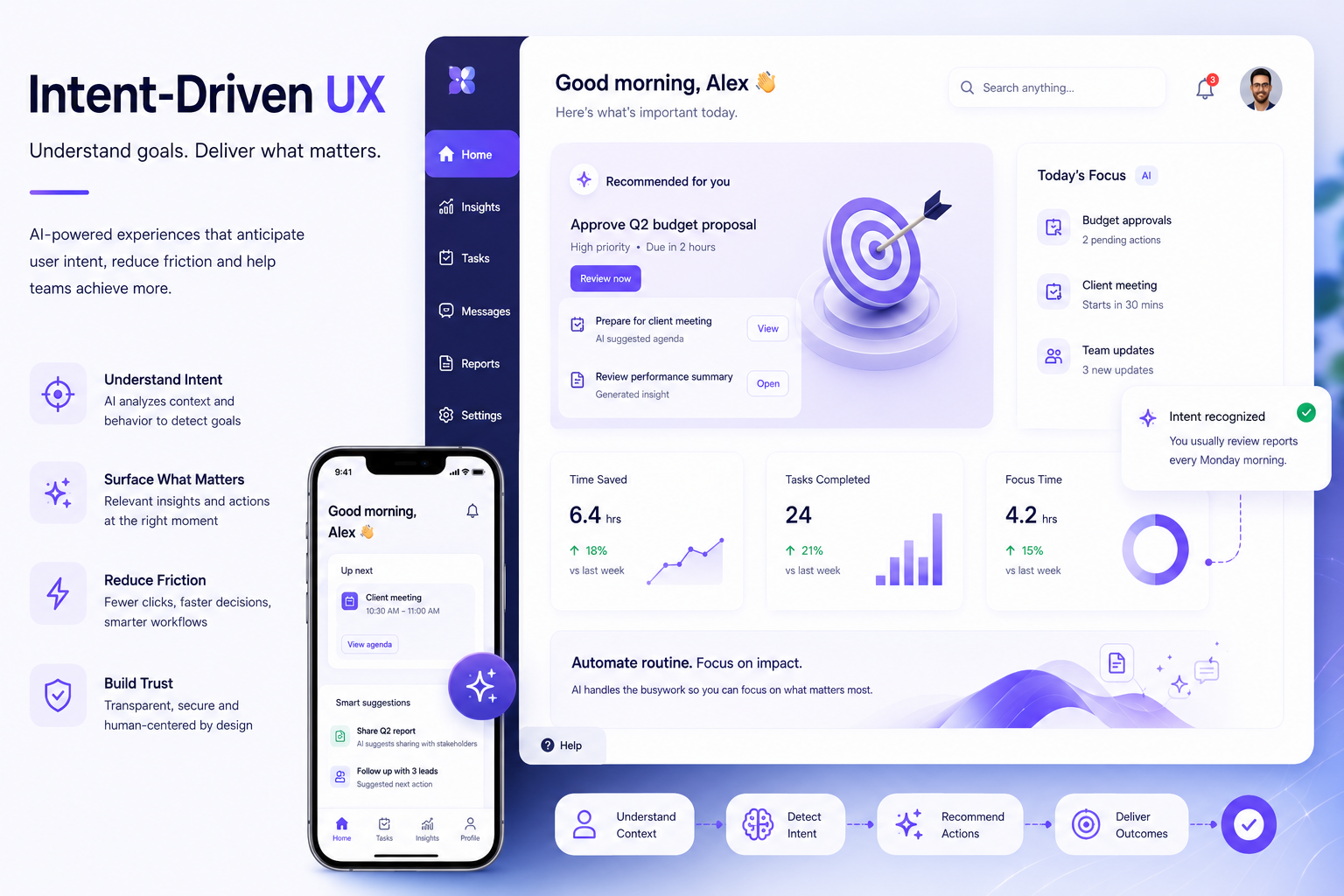
Traditional interfaces react to user actions. Intent-driven experiences proactively interpret user goals and present the most relevant information, tools, or workflows before users have to search for them.
Rather than asking employees to navigate multiple dashboards, applications can understand context through factors such as:
- User role
- Previous activity
- Business priorities
- Team collaboration
- Historical workflows
- Device and location context
The result is software that feels smarter, faster, and significantly easier to use.
Why Enterprise Organizations Are Prioritizing It
Large enterprises often operate across numerous departments, regions, and business systems. Employees frequently switch between applications just to complete routine tasks.
Intent-Driven UX addresses these challenges by helping organizations:
- Reduce cognitive load
- Accelerate workflow completion
- Improve employee productivity
- Increase feature adoption
- Minimize repetitive actions
- Deliver more personalized digital experiences
When software aligns with user intent, employees spend less time navigating interfaces and more time making business decisions.
AI Makes Intent Recognition Possible
Artificial intelligence plays a central role in understanding user behavior.
Modern enterprise platforms can analyze patterns, identify recurring workflows, and predict the next likely action. Instead of displaying generic dashboards, AI can recommend reports, summarize critical information, prioritize approvals, or surface customer insights at exactly the right moment.
This transforms enterprise applications from passive tools into active collaborators.
Building Trust Through Transparency
As applications become more intelligent, transparency becomes increasingly important.
Users should always understand:
- Why recommendations are displayed
- Which data influences AI decisions
- How automated actions can be reviewed
- When human approval is required
- How personal and organizational data is protected
Clear communication strengthens trust while supporting responsible AI adoption.
Measuring Business Impact
Intent-Driven UX should be evaluated using outcomes rather than visual appeal alone.
Organizations commonly measure success through:
- Employee productivity
- Workflow completion time
- User adoption rates
- Customer satisfaction
- Support ticket reduction
- Operational efficiency
These metrics help demonstrate how improved user experiences contribute directly to business performance.
Industry Perspective
Across enterprise product engineering, organizations are increasingly integrating UX research, AI engineering, cloud-native architecture, and product strategy into unified delivery models. Companies such as GeekyAnts have publicly shared enterprise work across healthcare, fintech, retail, and SaaS, reflecting the industry’s growing emphasis on creating intelligent products where user experience is treated as a strategic business capability rather than a final design step.
Conclusion
The future of enterprise UX is not defined by larger dashboards or more features. It is defined by software that understands user intent, minimizes unnecessary effort, and helps people achieve meaningful outcomes faster.
Organizations that embrace Intent-Driven UX today will build digital products that employees adopt more readily, customers trust more deeply, and businesses can scale with greater confidence in an increasingly AI-driven world.