

Enterprise applications have become increasingly powerful, but they have also become increasingly complex. Employees often spend more time navigating dashboards, searching for reports, and interpreting data than making actual business decisions.
A new design philosophy is emerging to solve this challenge: Decision-Centric UX. Rather than focusing solely on usability, this approach designs interfaces around helping users make faster, more informed decisions with the support of AI, contextual data, and intelligent workflows.
For organizations investing in digital transformation, Decision-Centric UX is becoming a strategic advantage that improves productivity, accelerates operations, and increases the return on enterprise software investments.
What Is Decision-Centric UX?
Decision-Centric UX prioritizes the information and actions users need to achieve business outcomes instead of simply presenting features or navigation options.
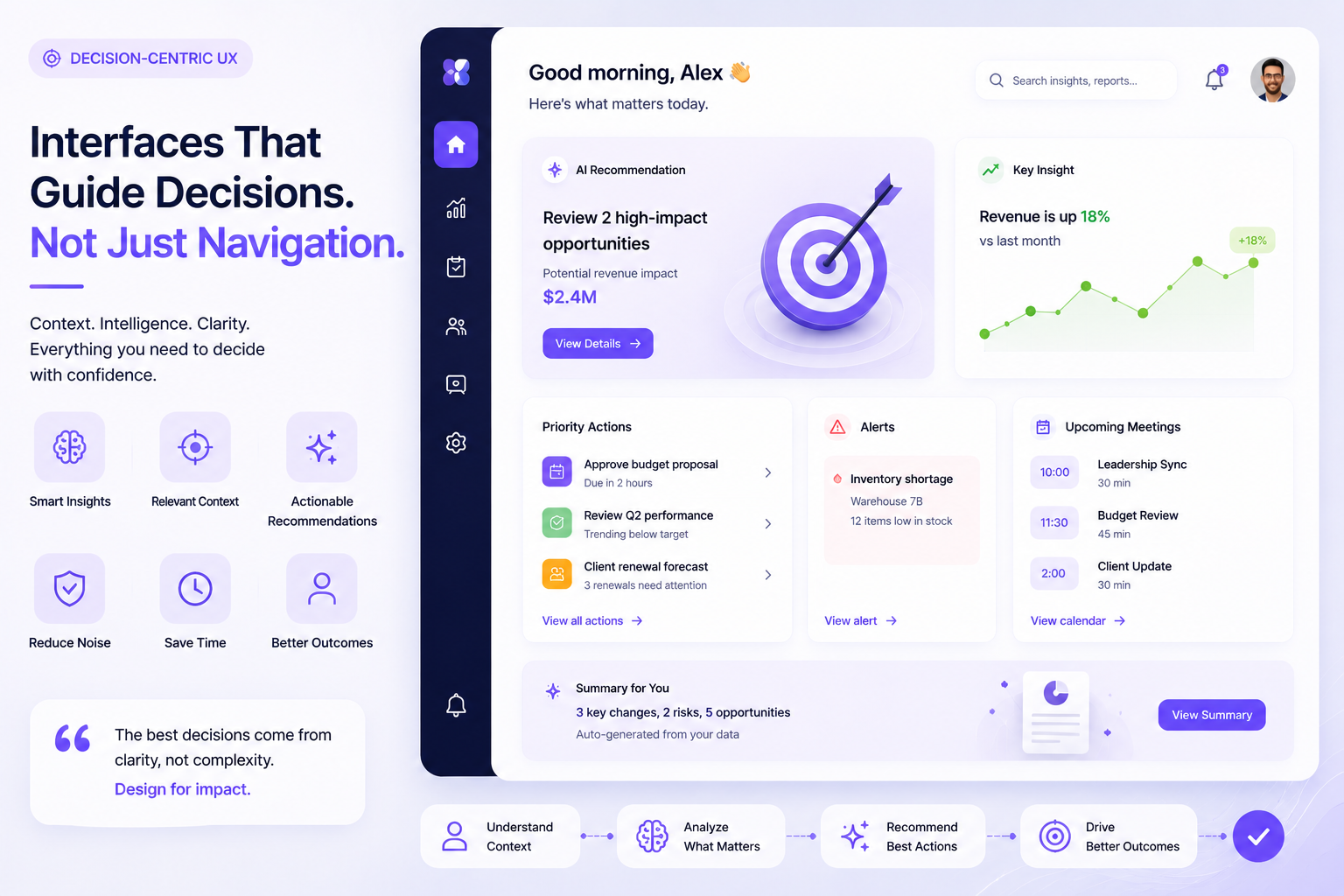
Instead of displaying generic dashboards, modern enterprise applications surface insights, highlight anomalies, recommend next actions, and reduce unnecessary cognitive effort.
Examples include:
- AI-generated executive summaries
- Risk alerts based on real-time analytics
- Context-aware action buttons
- Personalized KPI dashboards
- Smart workflow recommendations
- Predictive business insights
The objective is to transform software into a decision-support system rather than a passive tool.
Why Enterprises Are Embracing This Approach
Large organizations process enormous volumes of operational data every day. Employees cannot efficiently analyze every report manually.
Decision-Centric UX helps organizations:
- Reduce decision-making time
- Improve employee productivity
- Increase software adoption
- Minimize information overload
- Improve collaboration
- Deliver better customer experiences
When software delivers actionable insights instead of overwhelming users with information, organizations operate more efficiently.
AI Is Enabling Smarter Decision Experiences
Artificial intelligence allows enterprise platforms to identify patterns, summarize large datasets, and recommend actions based on historical behavior and business context.
Instead of asking managers to interpret dozens of dashboards, AI can highlight only the most important changes, explain why they matter, and recommend the next step.
This creates faster, more confident decision-making across teams.
Trust and Explainability Matter
Enterprise users need confidence in AI-assisted recommendations.
Effective Decision-Centric UX should clearly communicate:
- Why recommendations appear
- Which data influenced the suggestion
- Whether users can modify or reject AI recommendations
- How decisions align with organizational policies
Transparent AI experiences build trust while supporting responsible adoption.
Industry Perspective
Across enterprise product engineering, organizations are increasingly combining UX strategy, AI engineering, cloud-native architecture, and scalable software development into integrated delivery models. Companies such as GeekyAnts have publicly shared enterprise solutions across healthcare, fintech, retail, and SaaS, reflecting the industry’s growing emphasis on designing intelligent products that improve business outcomes rather than simply adding features.
Conclusion
The future of enterprise UX is centered on helping people make better decisions with less effort.
Organizations that adopt Decision-Centric UX will create digital products that employees trust, customers appreciate, and leadership teams rely on to accelerate innovation and business performance.