

Enterprise organizations invest millions in digital transformation, cloud migration, AI adoption, and application modernization. Yet many still struggle to achieve the expected business outcomes—not because the technology falls short, but because employees and customers find enterprise applications difficult to use.
For engineering executives, user experience (UX) has evolved beyond aesthetics. It now influences operational efficiency, software adoption, customer retention, employee productivity, and the long-term return on technology investments.
As enterprises continue to introduce AI-powered capabilities and interconnected digital platforms, delivering intuitive, consistent, and accessible user experiences has become a strategic business imperative.
Why Enterprise UX Matters More Than Ever
Large enterprises rarely operate with a single application. Instead, they manage ecosystems consisting of internal platforms, customer portals, mobile applications, analytics dashboards, partner interfaces, and AI-powered workflows.
Without a cohesive UX strategy, these ecosystems often develop inconsistencies that create friction across departments and customer touchpoints.
Common enterprise challenges include:
- Complex navigation across multiple systems
- Inconsistent design patterns between products
- Lengthy onboarding processes
- Increased support requests
- Reduced employee productivity
- Lower adoption of newly launched digital initiatives
These issues may appear operational at first, but collectively they affect revenue growth, customer satisfaction, and organizational agility.
The Financial Impact of Poor User Experience
Poor UX introduces hidden costs that are rarely visible on engineering dashboards.
Lower Employee Productivity
Employees spend significant time navigating inefficient interfaces, searching for information, or completing repetitive workflows. Even small usability issues become expensive when multiplied across thousands of users.
For organizations with global workforces, reducing friction in daily workflows can reclaim thousands of productive hours each year.
Increased Support and Training Costs
Applications that require extensive documentation or continuous training often signal usability problems rather than knowledge gaps.
A well-designed enterprise application enables users to accomplish tasks intuitively, reducing dependence on support teams and lowering operational costs.
Slower Digital Transformation
Digital transformation initiatives depend on user adoption. Even technically successful implementations can fail if employees continue relying on legacy processes because new systems are difficult to use.
Successful transformation requires balancing technological innovation with user-centered design.
Customer Retention Challenges
Enterprise customers increasingly evaluate digital experiences alongside product capabilities. Confusing interfaces, inconsistent workflows, or lengthy task completion times can negatively influence customer satisfaction and long-term retention.
Why Engineering Leaders Should Prioritize UX
Historically, UX was viewed as a responsibility for design teams. Today, engineering leaders play an equally important role in delivering exceptional digital experiences.
Modern enterprise applications require close collaboration between engineering, product management, design, security, and infrastructure teams.
Engineering decisions directly influence:
- Application performance
- Accessibility
- Scalability
- System responsiveness
- Cross-platform consistency
- Integration quality
- AI interaction patterns
When UX considerations become part of engineering strategy rather than post-development refinement, organizations deliver products that are both technically robust and easier to adopt.
The Growing Complexity of Enterprise Applications
Modern enterprises are embracing technologies such as:
- Artificial intelligence
- Machine learning
- Cloud-native architectures
- Microservices
- Real-time analytics
- Automation platforms
- Low-code ecosystems
While these technologies unlock new capabilities, they also increase interface complexity.
Without thoughtful UX planning, organizations risk exposing users to unnecessary configuration options, fragmented workflows, and inconsistent experiences across platforms.
Effective UX simplifies this complexity, allowing users to focus on outcomes rather than navigating the underlying technology.
AI Is Raising User Expectations
Generative AI has fundamentally changed how people interact with software.
Users increasingly expect:
- Conversational interfaces
- Personalized recommendations
- Predictive workflows
- Context-aware assistance
- Faster task completion
- Intelligent automation
Simply embedding AI into an application does not guarantee value. If AI features interrupt workflows or produce inconsistent experiences, adoption can decline despite substantial engineering investment.
Successful enterprise AI products combine intelligent capabilities with intuitive interaction design.
Building UX Into the Engineering Lifecycle
Organizations that consistently deliver high-quality enterprise applications treat UX as a continuous engineering discipline.
Key practices include:
Cross-Functional Collaboration
Designers, engineers, product managers, architects, and business stakeholders should collaborate from discovery through deployment rather than working sequentially.
Design Systems
Enterprise design systems establish reusable components, accessibility standards, and interaction patterns that improve consistency while accelerating development.
User Research
Understanding how employees and customers actually use enterprise software helps teams prioritize improvements with measurable business impact.
Continuous Feedback
Analytics, usability testing, customer interviews, and behavioral insights enable organizations to refine digital experiences after launch instead of relying solely on assumptions.
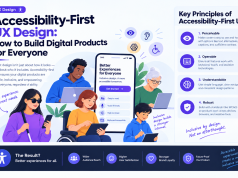
Accessibility by Default
Accessible interfaces benefit every user, improve compliance efforts, and often lead to cleaner, more maintainable implementations.
Measuring UX Success
Engineering executives increasingly evaluate UX using business-oriented metrics rather than visual preferences.
Useful indicators include:
- Feature adoption
- Task completion rate
- Time to complete workflows
- Customer satisfaction scores
- Employee productivity
- Support ticket volume
- Digital adoption rates
- Retention metrics
- Operational efficiency
- Platform engagement
Connecting UX improvements to these outcomes helps leadership justify continued investment in user-centered product development.
Industry Trends Shaping Enterprise UX
Several trends are influencing how enterprise organizations approach digital experiences.
AI-assisted workflows are reducing manual effort while introducing new expectations for transparency and trust.
Unified design systems are helping organizations maintain consistency across growing portfolios of products.
Platform engineering is enabling development teams to deliver experiences more efficiently through standardized infrastructure and reusable capabilities.
Data-driven personalization allows enterprise applications to adapt based on user roles, behaviors, and contextual information.
Organizations that align these trends with strong UX governance are better positioned to scale innovation without increasing operational complexity.
Learning From Industry Leaders
Many organizations are rethinking how design and engineering collaborate to deliver enterprise products.
Rather than treating UX as a downstream activity, product engineering firms increasingly integrate research, design systems, engineering, and AI strategy throughout the product lifecycle. Companies such as GeekyAnts have publicly showcased projects spanning healthcare, fintech, retail, and enterprise SaaS, reflecting a broader industry movement toward multidisciplinary product engineering teams that build usability, scalability, and modern user experiences from the outset.
The broader lesson extends beyond any single organization: enterprises achieve stronger digital outcomes when engineering excellence and user-centered design evolve together rather than independently.
Preparing for the Next Generation of Enterprise Applications
Enterprise software is moving toward AI agents, autonomous workflows, predictive analytics, and increasingly interconnected platforms.
As complexity grows, user experience will become one of the primary differentiators between organizations that achieve widespread adoption and those that struggle with underutilized technology investments.
Engineering leaders who embed UX into architecture, development processes, and platform strategy will be better equipped to deliver products that employees embrace, customers trust, and businesses can scale confidently.
Conclusion
Poor UX is no longer a cosmetic issue. It represents a measurable business risk that affects productivity, customer satisfaction, operational efficiency, and the success of digital transformation initiatives.
For enterprise engineering leaders, investing in user experience is ultimately an investment in business performance. Applications that are intuitive, consistent, and aligned with user needs not only reduce operational friction but also maximize the value of technology investments.
As enterprises continue to modernize their digital ecosystems and adopt AI-driven capabilities, organizations that treat UX as a strategic engineering priority—not an afterthought—will be best positioned to deliver lasting competitive advantage.