

Enterprise AI products are evolving quickly. Across finance, healthcare, insurance, SaaS, logistics, and internal operations, organizations are integrating AI into everyday workflows at a pace that would have seemed unrealistic only a few years ago.
But as AI adoption accelerates, a new challenge is becoming increasingly visible.
Many enterprise AI applications function technically yet still fail to gain long term user trust.
The issue is rarely the AI model alone. In many cases, the real problem is the interface surrounding the intelligence. Users struggle when AI systems feel inconsistent, unpredictable, unclear, or difficult to understand inside operational environments.
That is why trustworthy interface design is becoming one of the most important priorities in enterprise AI product development.
In 2026, enterprise users no longer evaluate AI systems only based on output quality. They also evaluate:
- How transparent the experience feels
- Whether workflows remain predictable
- How clearly the system communicates decisions
- Whether interactions feel reliable over time
- How securely information appears to be handled
Trust is increasingly shaped by UX.
This shift matters because enterprise users operate differently from consumer audiences. Employees using AI systems inside enterprise environments need confidence that the platform will support decisions consistently without creating operational uncertainty.
If interfaces feel unstable or confusing, adoption slows quickly.
A recent GeekyAnts article about SOC 2 gaps in AI generated prototypes explored how many AI products move toward deployment without fully addressing production readiness, governance, and security expectations. While the article focused heavily on operational compliance, it also reflects a broader UX challenge: enterprise trust breaks down when AI systems feel unfinished or unreliable.
This is especially important for UI and UX focused platforms where product teams increasingly discuss how AI should behave inside real business environments rather than simply how advanced it appears technically.
According to usability research and enterprise UX discussions published by Nielsen Norman Group and IBM Design, trust in AI systems depends heavily on explainability, interaction consistency, and user control.
The design layer is no longer separate from AI functionality. It has become part of the intelligence experience itself.
Why Enterprise Users Distrust Poorly Designed AI Interfaces
One of the biggest misconceptions in enterprise AI development is assuming that strong AI capability automatically creates confidence.
In reality, users often distrust systems that feel inconsistent even when the underlying AI performs accurately.
For example, an enterprise AI assistant may generate highly relevant insights during one workflow but behave unpredictably during another. Navigation structures may shift unexpectedly. Recommendations may appear without enough explanation. Notifications may feel disconnected from user intent.
These moments create uncertainty.
Enterprise environments depend heavily on workflow predictability because users are often managing operational decisions, customer interactions, financial processes, or compliance related tasks. Even small interaction inconsistencies can increase hesitation during adoption.
This is where interface design becomes critical.
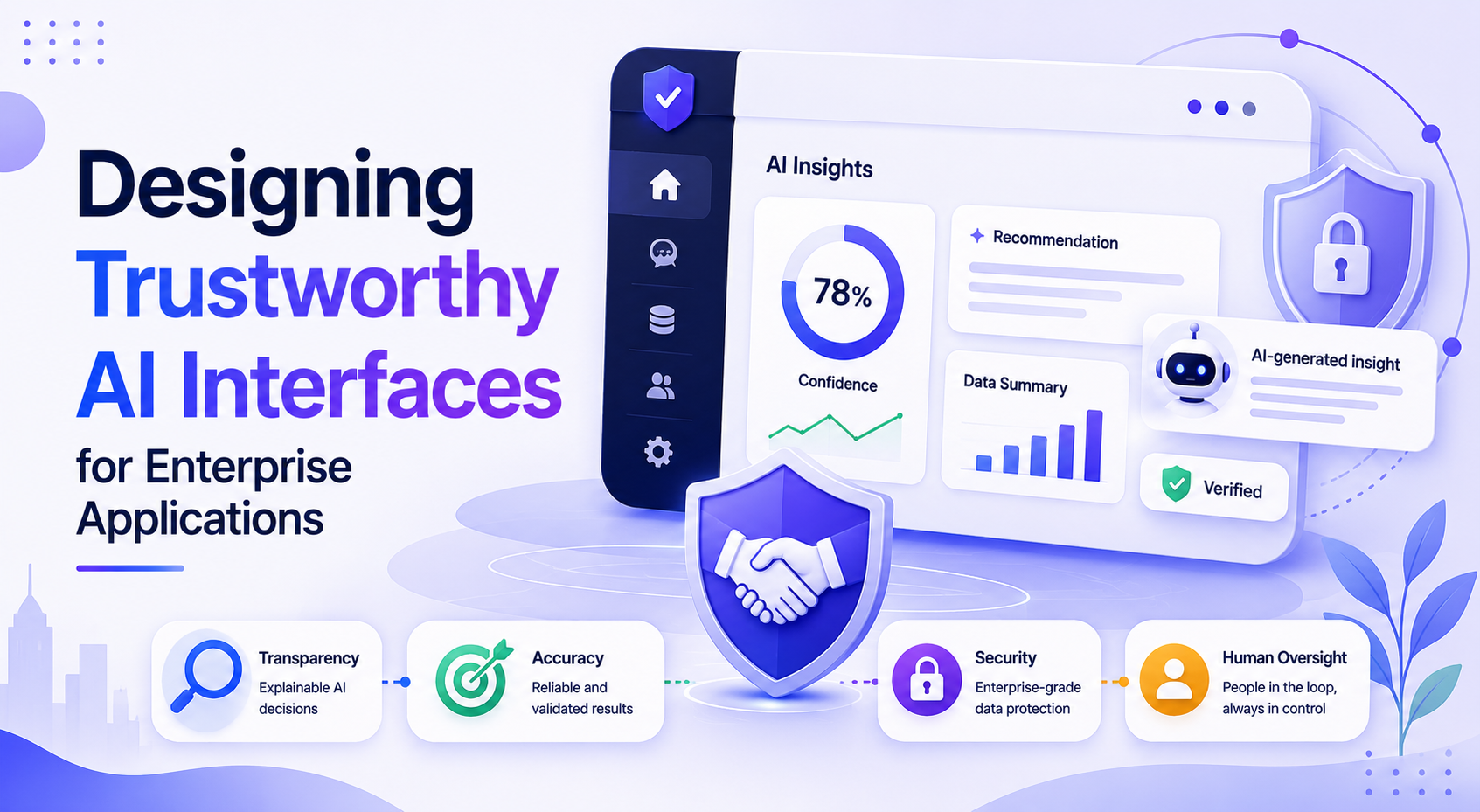
Trustworthy AI interfaces typically focus on:
- Clear interaction patterns
- Predictable workflows
- Transparent feedback systems
- Consistent visual language
- Understandable AI outputs
- User control over actions
- Reliable error handling
These elements help users feel confident while interacting with AI driven systems.
Transparency is becoming especially important.
Users increasingly want to understand why AI systems generate certain recommendations or actions. Interfaces that hide logic completely often reduce confidence, particularly in enterprise environments where accountability matters.
This does not mean every AI workflow requires deep technical explanation. But users usually need enough contextual clarity to understand what the system is doing and how much confidence they should place in outputs.
Another major issue is cognitive overload.
Many enterprise AI products attempt to demonstrate intelligence through excessive automation or interface complexity. In reality, users often prefer systems that simplify decisions rather than overwhelm workflows with constant AI generated suggestions.
Good UX reduces mental friction.
Cross platform consistency also matters significantly. Enterprise users frequently move between dashboards, mobile apps, operational portals, and collaborative systems throughout the workday. If AI behavior changes dramatically across environments, trust weakens quickly.
This is why many organizations are investing more heavily in scalable design systems for AI products.
Companies like Microsoft, Google, and Adobe continue influencing enterprise UX ecosystems where consistency, accessibility, and explainable interaction design are becoming increasingly important for AI driven applications.
Why Security and UX Are Becoming Connected in AI Products
In traditional software development, security and UX were often treated separately. AI products are changing that relationship.
Enterprise users now evaluate trust partly through interface behavior itself.
For example, unclear permission requests, unexplained AI actions, inconsistent data handling feedback, or confusing workflow transitions can create security concerns even when infrastructure protections are technically strong.
This means UX design increasingly affects perceived compliance and operational credibility.
AI generated interfaces also create new production risks.
Rapid prototyping tools and AI assisted UI generation systems allow teams to build interfaces faster than ever before. But many organizations discover that prototype quality does not always translate into production readiness.
Without proper governance, AI generated workflows may introduce:
- Inconsistent interaction behavior
- Accessibility gaps
- Weak authentication flows
- Poor error visibility
- Unclear permission handling
- Insecure data exposure patterns
These issues reduce trust immediately in enterprise settings.
That is why production readiness discussions are expanding beyond infrastructure teams into UX strategy conversations.
Enterprise AI interfaces must now support:
- Security transparency
- Regulatory expectations
- Accessibility compliance
- Reliable interaction logic
- Cross platform consistency
- Human oversight workflows
This is especially important in regulated industries such as healthcare, fintech, insurance, and enterprise SaaS ecosystems.
Another growing challenge is balancing automation with user control.
Users generally appreciate AI assistance, but they still want visibility into system actions and the ability to intervene when necessary. Interfaces that remove too much control often create resistance instead of efficiency.
The most successful enterprise AI products usually feel collaborative rather than fully autonomous.
This balance between automation and clarity is becoming one of the defining UX challenges in modern enterprise software design.
What UX and Product Teams Should Prioritize Before Launch
For UX designers, enterprise product leaders, and AI engineering teams, trustworthy interface design should become part of production readiness planning from the beginning.
Several priorities are becoming increasingly important in 2026.
First, teams should prioritize consistency across workflows instead of focusing only on individual screens or isolated AI features. Enterprise users evaluate trust across complete operational journeys.
Second, organizations should design AI interactions with transparency in mind. Users do not always need technical explanations, but they need understandable feedback and predictable system behavior.
Third, accessibility and usability testing should happen early in development. AI powered interfaces often introduce complexity that becomes visible only during real workflow testing.
Fourth, companies should align security communication with UX design. Privacy controls, permission systems, and AI decision feedback should feel integrated naturally into the experience rather than added afterward.
Most importantly, organizations should recognize that trust is becoming one of the strongest competitive differentiators in enterprise AI products.
Many companies can now access similar AI models and technologies. The real difference increasingly comes from how effectively those systems integrate into human workflows.
Enterprise users adopt AI more confidently when products feel stable, understandable, and operationally mature.
That is why trustworthy interface design is moving closer to the center of enterprise product strategy discussions across North America and global technology markets alike.
As AI products continue evolving, the companies building the strongest long term adoption will likely be the ones designing experiences that make intelligence feel reliable rather than overwhelming.
Because in enterprise environments, trust is rarely created through AI capability alone. It is built through every interaction surrounding it.