

The music learning app market has evolved far beyond digital metronomes and video lesson libraries. In 2026, users expect music education platforms to feel intelligent, personalized, interactive, and emotionally rewarding from the very first session.
That shift is changing how product teams approach UX design.
For years, many music learning applications focused heavily on content quantity. More lessons, more instruments, more practice exercises. But user retention data across the EdTech and learning app industry continues showing the same pattern: users leave quickly when the learning experience feels repetitive, disconnected, or overwhelming.
The challenge is especially visible in mobile-first learning environments.
Modern users are not only comparing music learning apps against competitors in the education category. They are comparing them against the best digital experiences they use every day streaming platforms, fitness apps, gaming ecosystems, and AI-powered productivity tools.
That means UX has become one of the biggest competitive differentiators in music education technology.
Applications that simplify onboarding, personalize learning journeys, reduce practice friction, and create habit-forming experiences are seeing stronger retention and engagement. Meanwhile, apps with cluttered interfaces, rigid lesson flows, or generic progression systems struggle to maintain long-term user attention.
According to industry reporting from sources like Duolingo’s engineering and product insights and Google UX Design research, learning platforms increasingly rely on behavioral UX strategies to improve user consistency and long-term engagement.
This trend is influencing music learning platforms directly.
The most successful applications are no longer designed only around teaching music theory or instrument skills. They are designed around maintaining motivation.
That distinction matters because learning music is emotionally demanding. Users experience frustration, inconsistency, skill plateaus, and confidence drops regularly. UX design now plays a major role in helping users move through those moments without abandoning the product entirely.
A recent GeekyAnts case study on multi-platform music lesson accountability apps explored how accountability-driven experiences, multi-device accessibility, and personalized lesson tracking are becoming increasingly important for music education products trying to improve learner consistency.
The market direction is clear: successful music learning apps are increasingly behaving less like static education software and more like adaptive digital ecosystems.
Why Many Music Learning Apps Lose Users Early
One of the biggest challenges in music learning UX is balancing structure with flexibility.
New learners often need guidance, but overly rigid learning systems create pressure and frustration quickly. On the other hand, completely open-ended lesson systems often overwhelm users who do not know where to begin.
Many music learning platforms struggle because they optimize for curriculum delivery instead of user behavior.
A beginner learning piano on a mobile app may initially feel motivated, but motivation fades fast when practice sessions become repetitive or progress feels unclear. If the app does not provide emotional reinforcement, adaptive recommendations, or visible milestones, users often disengage within weeks.
This is why personalization has become central to modern music learning UX.
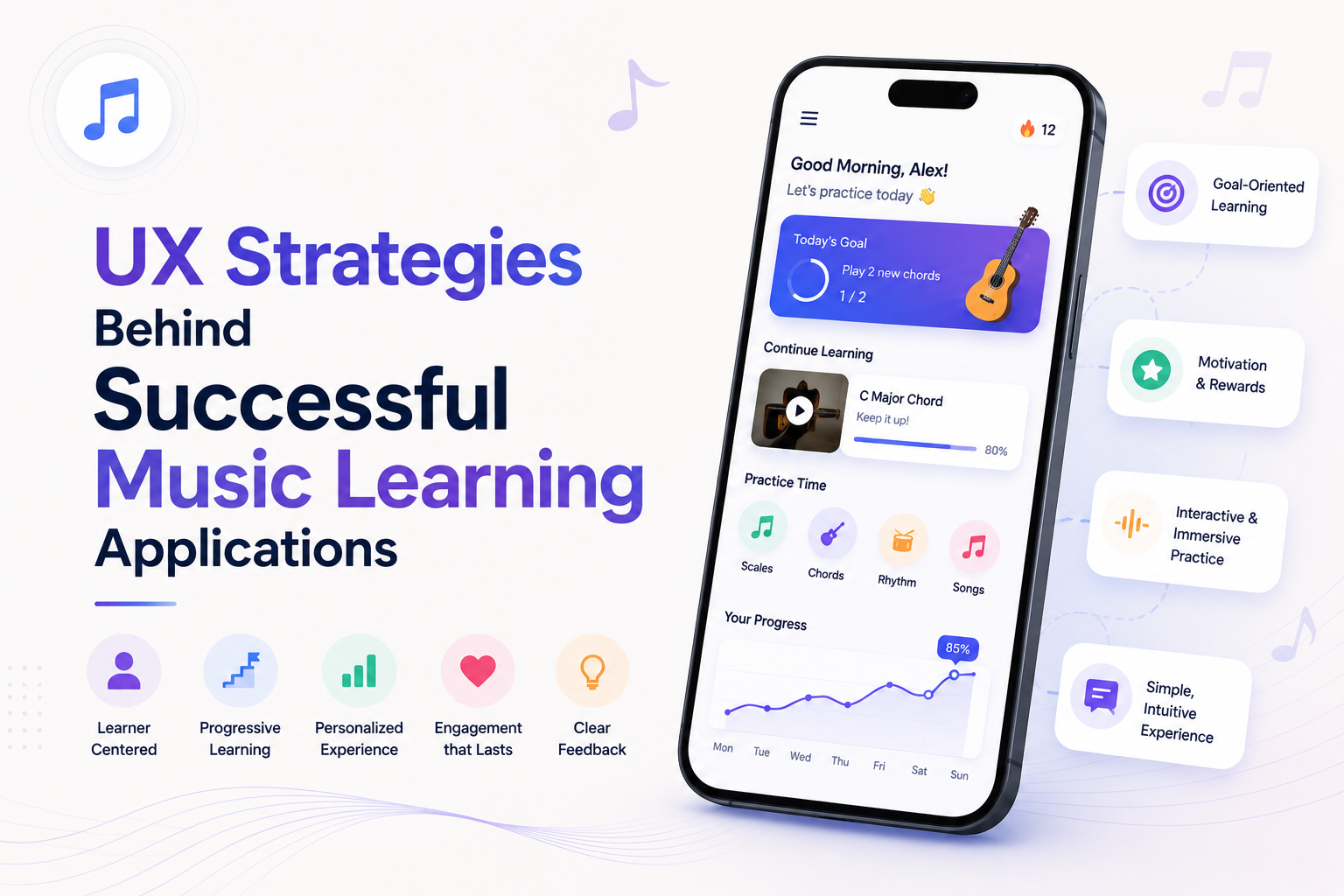
Instead of pushing identical lesson paths to every learner, successful platforms now adapt experiences based on:
- Skill progression
- Practice consistency
- Learning pace
- Instrument preference
- User goals
- Session history
- Engagement patterns
This creates more relevant and sustainable learning journeys.
Spotify’s personalization model has also influenced broader digital product expectations. Users now expect apps to understand behavior patterns automatically. Music learning applications are beginning to apply similar thinking through adaptive lesson recommendations and AI-assisted learning flows.
Gamification still plays an important role, but the strategy has matured.
Early learning apps often relied heavily on streaks, badges, and reward systems. While those elements can improve short-term engagement, users eventually lose interest if the actual learning experience feels disconnected from real progress.
Modern UX strategies focus more on meaningful feedback loops.
For example, instead of simply rewarding lesson completion, successful music apps increasingly provide:
- Real-time performance feedback
- AI-assisted error correction
- Adaptive practice difficulty
- Personalized improvement suggestions
- Progress visualization systems
These experiences create a stronger sense of advancement.
Another growing factor is emotional UX design.
Music learning is highly personal. Poor UX decisions can make users feel inadequate or discouraged quickly. Applications that create supportive, low-pressure learning environments often retain users longer than platforms focused purely on performance metrics.
This is especially relevant for younger users and adult beginners returning to music education after years away from practice.
The Shift Toward Multi-Platform Learning Experiences
The way users engage with music education platforms has changed significantly over the past few years.
Learning no longer happens in one location or on one device.
A user may begin a lesson on a tablet, review practice notes on a smartphone, watch tutorials on a laptop, and track progress through wearable integrations or connected smart instruments. This behavior is pushing product teams toward multi-platform UX strategies.
Cross-platform consistency is becoming essential.
Users expect lesson continuity, synced progress tracking, and frictionless transitions between devices. Apps that fail to provide seamless experiences across platforms often struggle with retention because interruptions break learning momentum.
This is where product architecture and UX strategy increasingly overlap.
Modern music learning applications now depend heavily on:
- Cloud synchronization
- Real-time progress tracking
- Personalized recommendation systems
- Cross-platform design systems
- AI-driven learning analytics
- Scalable mobile infrastructure
These technical foundations directly influence user experience quality.
A recent article published on Nielsen Norman Group highlighted how digital learning experiences increasingly depend on reducing cognitive friction rather than simply improving visual design. That principle is especially important for music learning platforms where users already face high mental effort during practice sessions.
Another major UX trend shaping the industry is accountability-driven learning.
Many users struggle with consistency more than capability. As a result, successful music apps are introducing features designed around motivation reinforcement rather than only lesson delivery.
This includes:
- Guided practice reminders
- Mentor feedback systems
- Community accountability features
- Progress journaling
- Collaborative learning environments
These systems help transform isolated practice into a more sustainable routine.
A recent GeekyAnts article exploring music lesson accountability platforms examined how accountability-focused UX patterns can improve long-term learner engagement across multi-device ecosystems.
This reflects a broader industry shift toward retention-focused product design.
What Product Teams Should Prioritize in 2026
For product leaders, UX designers, and engineering teams building music learning applications, the competitive landscape is changing rapidly.
The platforms succeeding today are not necessarily the ones with the largest lesson libraries. They are often the ones reducing friction most effectively while helping users maintain motivation consistently.
Several priorities are becoming increasingly important.
First, personalization should extend beyond recommendations. Users increasingly expect adaptive learning journeys that respond intelligently to progress, consistency, and performance patterns.
Second, product teams should focus on emotional retention as much as feature expansion. Motivation design is becoming a core UX discipline within digital learning products.
Third, cross-platform continuity needs to feel seamless. Learning interruptions caused by synchronization issues or inconsistent interfaces reduce engagement quickly.
Fourth, AI-assisted learning experiences will likely become more influential over the next few years. Real-time feedback, intelligent lesson adaptation, and conversational learning assistants are already reshaping how users interact with educational platforms.
Most importantly, music learning apps should prioritize simplicity.
Many educational platforms become overloaded with features that increase cognitive friction rather than improving learning quality. Clean navigation, intuitive workflows, and low-pressure onboarding experiences often outperform feature-heavy ecosystems.
As digital learning markets continue evolving, UX strategy is becoming one of the strongest differentiators between apps users abandon after a week and platforms they continue using for years.
That is why many companies building next-generation learning experiences are increasingly investing in product research, cross-platform engineering, and retention-focused UX systems designed specifically around long-term user behavior rather than short-term engagement spikes.
The future of music learning applications will likely belong to platforms that make progress feel achievable, consistent, and emotionally rewarding not just educational.