

Enterprise AI adoption is no longer limited by model performance. In 2026, most large organizations already have access to capable AI systems, copilots, and automation platforms. The bigger challenge now is usability. Many enterprise applications still struggle with poor AI adoption because employees do not trust the experience, understand the outputs, or integrate AI into daily workflows.
This has pushed human-centered AI design into a boardroom conversation.
For technology leaders managing enterprise platforms across North America, the pressure is operational. AI investments are expected to improve productivity, reduce support overhead, accelerate decision-making, and modernize customer experiences. But when AI interfaces feel confusing or disruptive, adoption slows down and ROI becomes difficult to justify.
Large enterprises are starting to realize that AI products cannot be designed like traditional SaaS dashboards. Employees expect interfaces that feel contextual, adaptive, and conversational without sacrificing governance or reliability.
According to recent industry reporting from firms like Gartner and McKinsey, enterprise AI initiatives continue to scale rapidly, but adoption challenges remain closely tied to user trust and workflow integration. Organizations that prioritize AI usability are seeing faster internal adoption and measurable efficiency gains.
The shift is especially visible in industries with complex operations such as banking, healthcare, logistics, manufacturing, and enterprise retail. Teams no longer want isolated AI widgets embedded inside software. They want AI systems that actively reduce operational friction.
Why Enterprise AI Interfaces Fail Inside Large Organizations
Many enterprise AI products fail because they introduce intelligence without redesigning workflows.
In large organizations, employees already operate across fragmented systems, legacy tools, approval chains, and compliance-heavy processes. Adding AI into those environments without simplifying the experience creates more cognitive load instead of reducing it.
This is where many enterprise applications break down.
For example, an AI-powered analytics platform may generate accurate insights, but if employees cannot verify the source of recommendations or understand why certain outputs appear, trust declines quickly. The same issue appears in AI copilots integrated into CRM systems, internal support tools, or enterprise knowledge platforms.
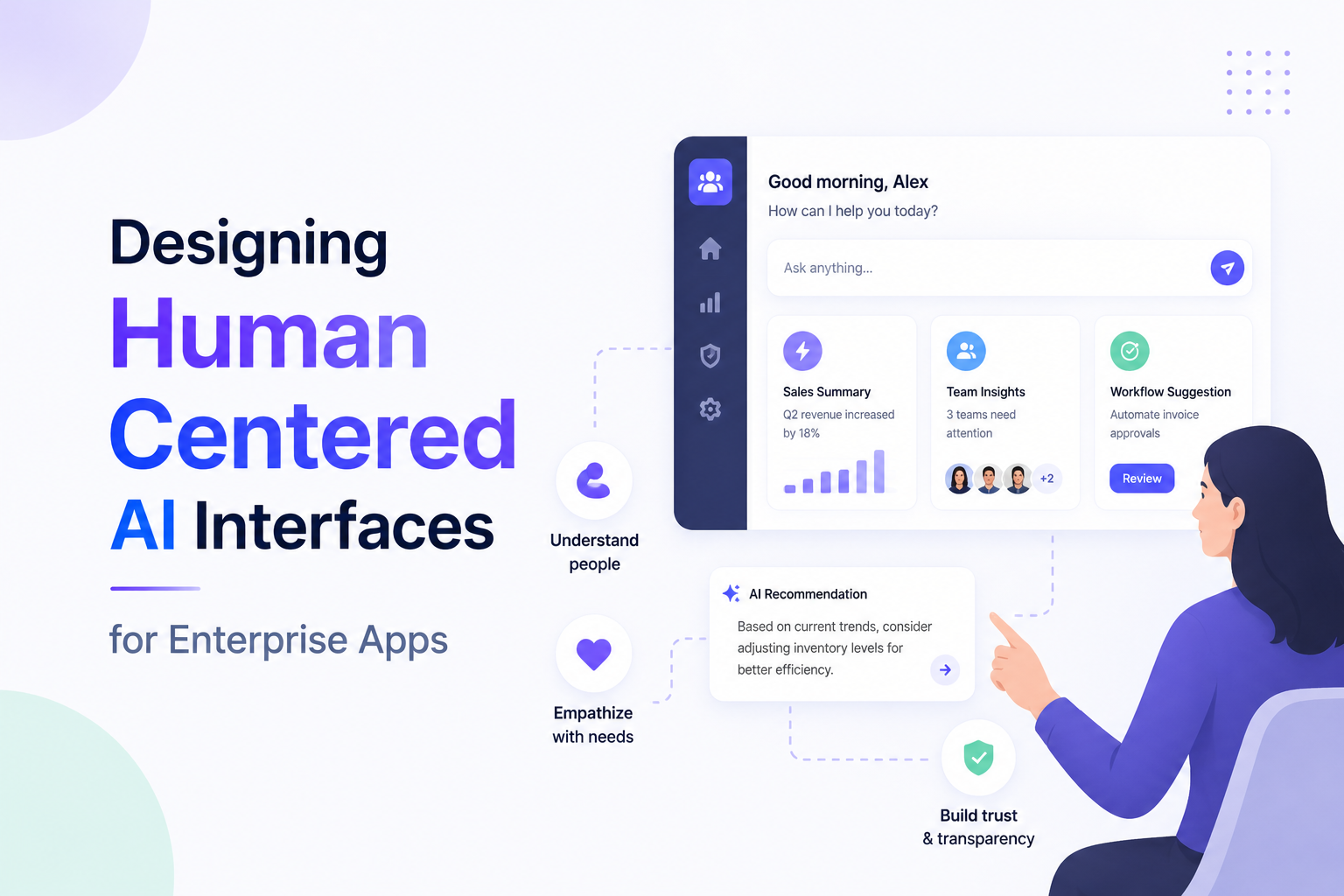
Human-centered AI interfaces focus on three priorities:
- Reducing decision fatigue
- Improving transparency
- Embedding AI naturally into existing workflows
This approach changes how enterprise applications are designed.
Instead of forcing users to learn entirely new systems, modern AI experiences are becoming task-oriented. Interfaces now prioritize guided actions, contextual recommendations, conversational search, and predictive workflows.
Large enterprises are also paying closer attention to explainable AI experiences. Employees want to understand how recommendations are generated, especially in sectors where operational risk and compliance matter.
This trend is influencing platform engineering teams as well. AI design decisions now affect infrastructure planning, API architecture, observability, and governance models. The interface is no longer just a front-end concern. It directly impacts enterprise adoption metrics.
Companies like Accenture, GeekyAnts and Thoughtworks are increasingly working with enterprises on AI product modernization strategies that combine UX design, platform engineering, and AI integration planning together rather than treating them as separate initiatives.
The Rise of Conversational Enterprise Experiences
The biggest interface shift happening in enterprise software today is the movement from dashboard-heavy experiences toward conversational workflows.
Employees increasingly expect enterprise systems to behave more like intelligent collaborators rather than static tools.
This trend accelerated after the mainstream adoption of generative AI platforms. Enterprise users became comfortable interacting with AI through natural language interfaces. That expectation is now influencing internal product design decisions across large organizations.
Instead of navigating complex enterprise menus, employees want to ask systems direct questions, automate repetitive tasks, summarize large datasets, or generate operational reports instantly.
This is changing the architecture of enterprise applications.
Modern AI interfaces now combine:
- Conversational search
- AI copilots
- Context-aware recommendations
- Workflow automation
- Predictive assistance
- Multi-modal interactions
For enterprise technology leaders, the challenge is balancing simplicity with governance.
Large organizations cannot deploy consumer style AI interfaces without considering data access, compliance, auditability, and security. This creates a design tension between flexibility and control.
As a result, enterprise AI interfaces are becoming layered experiences. Users receive simplified conversational interactions on the surface while backend systems maintain strict governance structures underneath.
This is particularly important for organizations managing thousands of employees across distributed operational environments.
AI agents are also becoming more prominent inside enterprise ecosystems. Instead of simple chatbot interactions, organizations are experimenting with AI systems capable of completing tasks autonomously across connected enterprise applications.
This shift is increasing demand for scalable AI-native product engineering frameworks that support orchestration, monitoring, and human oversight simultaneously.
According to industry analysts, enterprise spending on generative AI infrastructure and AI-enabled applications continues to rise significantly across North America, especially among Fortune 500 organizations prioritizing digital transformation and operational modernization.
What Enterprise Leaders Should Prioritize in 2026
For enterprise decision-makers, the conversation is no longer about whether AI should be integrated into products. The focus is now on how AI experiences can improve operational outcomes without creating new layers of complexity.
Several priorities are becoming increasingly important for enterprise teams.
First, AI interfaces must align with employee workflows instead of forcing workflow changes too early. Adoption improves when AI reduces operational effort immediately.
Second, platform teams need stronger collaboration between engineering, UX, and AI governance stakeholders. Many enterprise AI rollouts fail because technical implementation and user experience planning happen independently.
Third, enterprises need scalable design systems built specifically for AI-driven interactions. Traditional UI libraries were not designed for conversational workflows, dynamic recommendations, or autonomous task execution.
Fourth, organizations should prioritize measurable AI usability metrics rather than focusing only on model performance. User retention, workflow completion rates, employee productivity gains, and support ticket reduction often provide clearer business indicators than benchmark accuracy alone.
Technology leaders are also paying closer attention to AI fatigue inside organizations. Employees already operate across multiple collaboration platforms, dashboards, and automation systems. Poorly designed AI experiences can increase frustration rather than productivity.
This is why human-centered AI design is becoming a competitive differentiator.
The organizations seeing stronger AI adoption are treating AI interfaces as operational infrastructure instead of experimental features. They are investing in product thinking, platform scalability, governance frameworks, and experience design simultaneously.
That shift is creating new opportunities for enterprise technology consulting firms, AI product engineering companies, and platform modernization specialists working with large-scale digital ecosystems.
Companies exploring enterprise AI transformation strategies are increasingly evaluating partners that understand both engineering complexity and user adoption challenges. Teams across the industry, including firms like GeekyAnts, are contributing to this transition by helping enterprises rethink how AI-native digital products should function at scale.
As enterprise AI adoption accelerates through 2026, the organizations that succeed will likely be the ones that design AI systems employees actually want to use not just systems that technically work.