

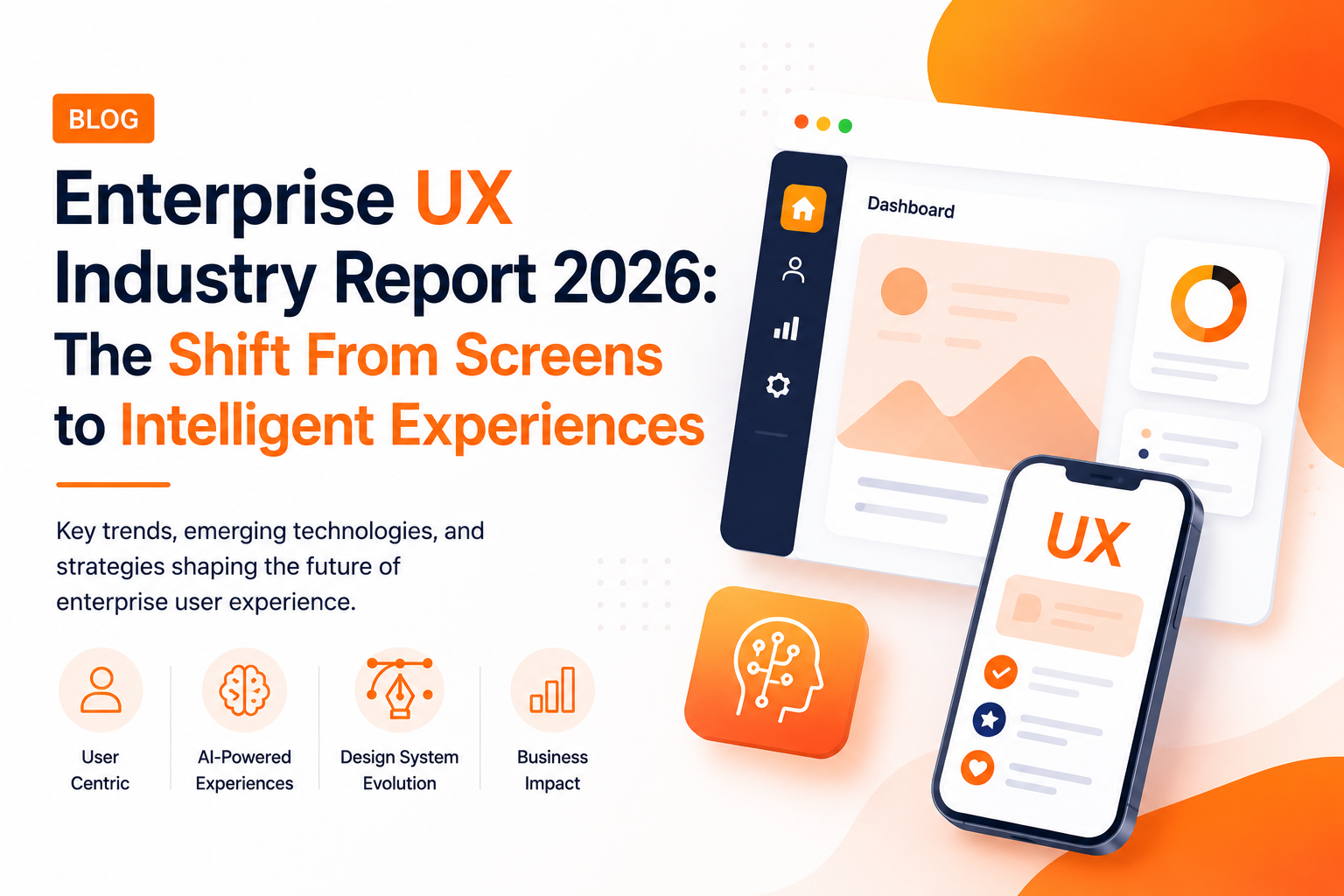
Enterprise UX is entering a new phase. For years, organizations focused on making software easier to navigate. In 2026, the bigger challenge is making software intelligent enough to understand context, reduce unnecessary work, and help users reach outcomes faster.
The rise of generative AI, AI agents, multimodal interfaces, personalization, and design systems is changing how enterprise products are designed and evaluated.
For technology and digital transformation leaders, UX is increasingly becoming a business-performance discipline rather than simply a visual design function.
The Enterprise UX Market Is Moving Toward Intelligence
Traditional enterprise applications were primarily command-driven. Users searched for information, opened dashboards, entered data, and manually completed workflows.
AI is changing this model.
Modern interfaces increasingly anticipate what users need and provide relevant information or actions automatically.
This shift is visible through:
- AI copilots
- Natural-language interfaces
- Predictive recommendations
- Intelligent search
- Automated summaries
- Context-aware dashboards
- Multimodal interactions
The objective is not to add more features. It is to reduce the amount of effort required to complete meaningful work.
UX Is Becoming a Productivity Layer
For organizations with thousands of employees, small improvements in usability can have significant operational consequences.
Consider an employee who spends several minutes searching across multiple systems for information every day. An intelligent search or AI assistant that reduces this effort can create substantial productivity gains when multiplied across an enterprise workforce.
This is why UX metrics are increasingly connected with business metrics such as:
- Task completion time
- Employee productivity
- Feature adoption
- Customer retention
- Support volume
- Workflow efficiency
The conversation is moving from “Does the interface look good?” to “Does the interface improve outcomes?”
Design Systems Are Becoming AI-Ready
Design systems remain important, but their role is expanding.
Modern design systems need to support not only buttons, forms, and navigation but also emerging AI interaction patterns.
These can include:
- AI response states
- Confidence indicators
- Human approval workflows
- AI-generated content
- Conversational interfaces
- Error recovery
- Personalization
A mature design system gives distributed product teams a common foundation while allowing AI experiences to remain consistent across platforms.
The Rise of Multimodal Enterprise UX
Users increasingly expect to interact with software through more than traditional screens.
Voice, text, images, gestures, and conversational interfaces can work together to create more flexible experiences.
For example, a field employee could photograph equipment, ask a voice question, and receive an AI-generated troubleshooting recommendation without navigating multiple menus.
This approach can be particularly valuable in healthcare, logistics, manufacturing, financial services, and field operations.
Accessibility Is Becoming a Strategic Requirement
Enterprise accessibility is also evolving.
Organizations are moving beyond basic compliance toward inclusive experiences that work effectively across different devices, environments, abilities, and interaction methods.
Accessible UX can improve usability for everyone, especially when applications incorporate voice, AI assistants, responsive interfaces, and multimodal interaction.
Industry Perspective
The broader product engineering industry is increasingly combining UX research, AI engineering, design systems, and cloud-native development into integrated product teams. Companies such as GeekyAnts have publicly showcased work across fintech, healthcare, retail, and SaaS, reflecting this wider movement toward treating UX as a strategic component of digital product engineering.
What Enterprise Leaders Should Watch Next
The most important UX developments over the next few years will likely center around:
- AI-native interfaces
- Agent-assisted workflows
- Multimodal interaction
- Personalized enterprise dashboards
- AI-ready design systems
- Explainable AI experiences
- Outcome-based UX measurement
Organizations that prepare for these changes early can avoid rebuilding their digital experiences every time a new interaction model emerges.
Conclusion
Enterprise UX is moving from interface design toward intelligent experience design.
The strongest products will not necessarily contain the most features. They will be the products that understand users, reduce friction, provide relevant context, and help people accomplish important tasks faster.
For enterprise technology leaders, investing in UX now means preparing the organization for a future where software becomes increasingly proactive, personalized, and intelligent.