


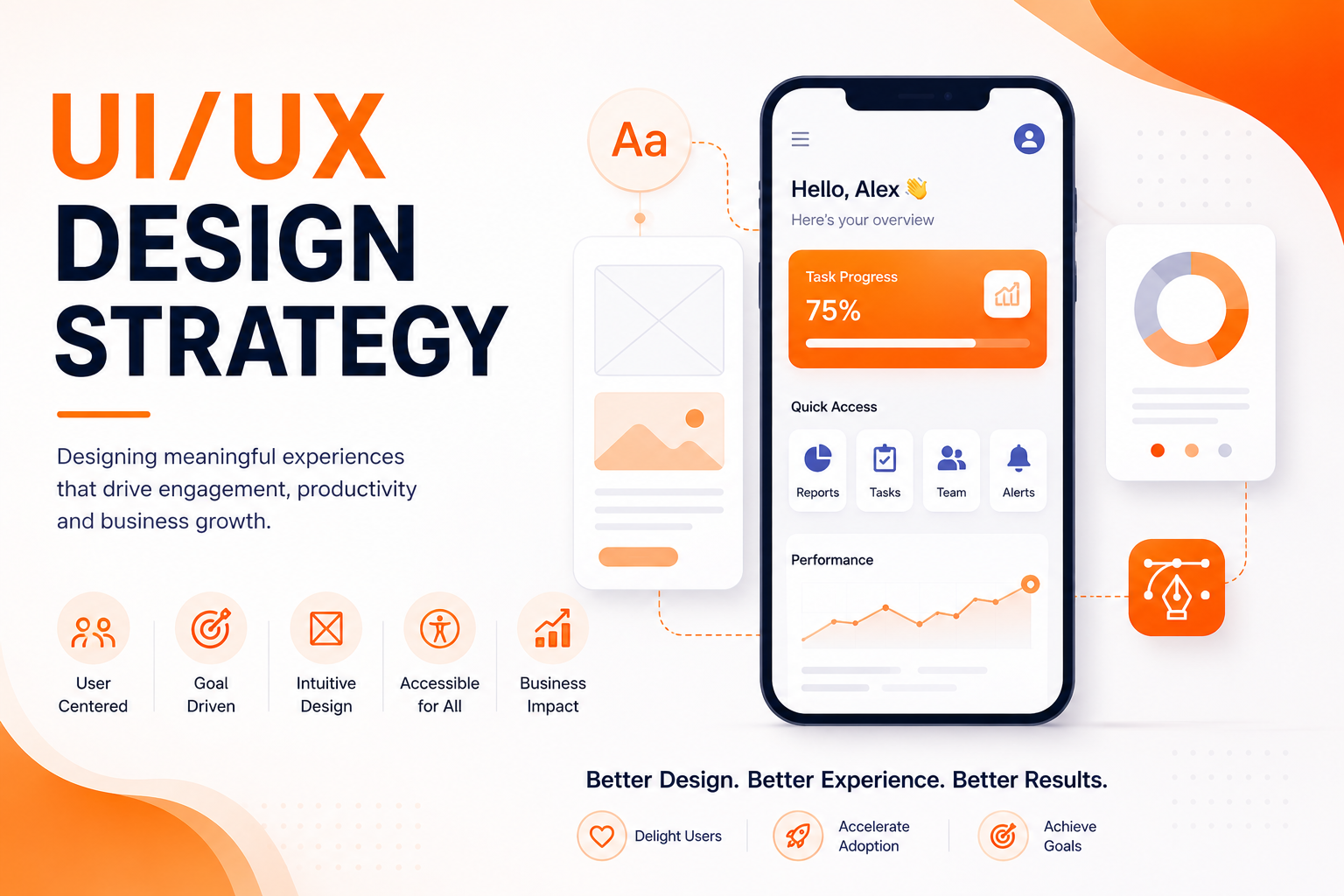
Enterprise UX is becoming harder to get right. Modern products must support complex workflows, multiple user roles, AI-powered features, accessibility requirements, and increasingly fragmented digital environments.
For large organizations, choosing a UX strategy is therefore not simply a design decision. It can influence adoption, productivity, development costs, and the long-term scalability of digital products.
A structured enterprise UX decision framework helps product and technology leaders determine which design approach best fits their business requirements.
Start With the Business Problem
The first decision should not be about colors, components, or design tools. It should be about the problem the product needs to solve.
Organizations should identify whether the primary objective is:
- Improving employee productivity
- Modernizing a legacy application
- Increasing customer engagement
- Simplifying complex workflows
- Introducing AI capabilities
- Creating a consistent digital ecosystem
The business objective determines what the UX strategy should prioritize.
Evaluate the User and Workflow Complexity
Enterprise applications can have thousands of users with very different responsibilities.
A finance administrator may need detailed controls, while an executive may require only high-level insights.
UX decisions should therefore consider:
- User roles
- Frequency of use
- Workflow complexity
- Technical expertise
- Accessibility requirements
- Device and platform usage
Personalization can help different users access the information they need without creating separate products for every role.
Decide Where AI Adds Real Value
AI should solve a genuine user problem rather than simply being added because it is trending.
High-value UX applications of AI include:
- Natural-language search
- Intelligent recommendations
- Automated summaries
- Predictive workflows
- AI copilots
- Context-aware notifications
The best approach is to identify where users currently spend unnecessary time and determine whether AI can safely remove that friction.
Choose Between Standardization and Flexibility
Enterprise organizations often manage multiple products and business units. A centralized design system can create consistency, but excessive standardization can make products feel rigid.
A balanced approach should establish common foundations for:
- Navigation
- Typography
- Components
- Accessibility
- Interaction patterns
- AI experiences
Teams can then introduce flexibility where individual workflows require it.
Measure Before Scaling
A UX strategy should be validated before being deployed across an entire organization.
Useful measurements include:
- Task completion time
- Error rates
- Feature adoption
- User satisfaction
- Support requests
- Employee productivity
These metrics provide evidence for deciding whether an experience should be expanded, redesigned, or replaced.
Industry Perspective
The enterprise product engineering industry is increasingly bringing UX strategy, AI engineering, and scalable software development together rather than treating them as separate disciplines. Companies such as GeekyAnts have publicly showcased work across areas including fintech, healthcare, retail, and SaaS, reflecting this broader movement toward building digital products around measurable user and business outcomes.
Final Takeaway
The right enterprise UX strategy depends on the organization’s users, workflows, technology landscape, and business objectives.
Rather than following every new UX trend, technology leaders should evaluate each approach against measurable outcomes. A structured decision framework makes it easier to build experiences that are intuitive today while remaining adaptable as enterprise technology continues to evolve.