

Enterprise products often have no shortage of data.
Teams can see which features users open, where sessions end, how long workflows take, and which screens generate the most activity. Yet having more data does not automatically lead to better UX decisions.
The real challenge is connecting behavioral data with what users actually need.
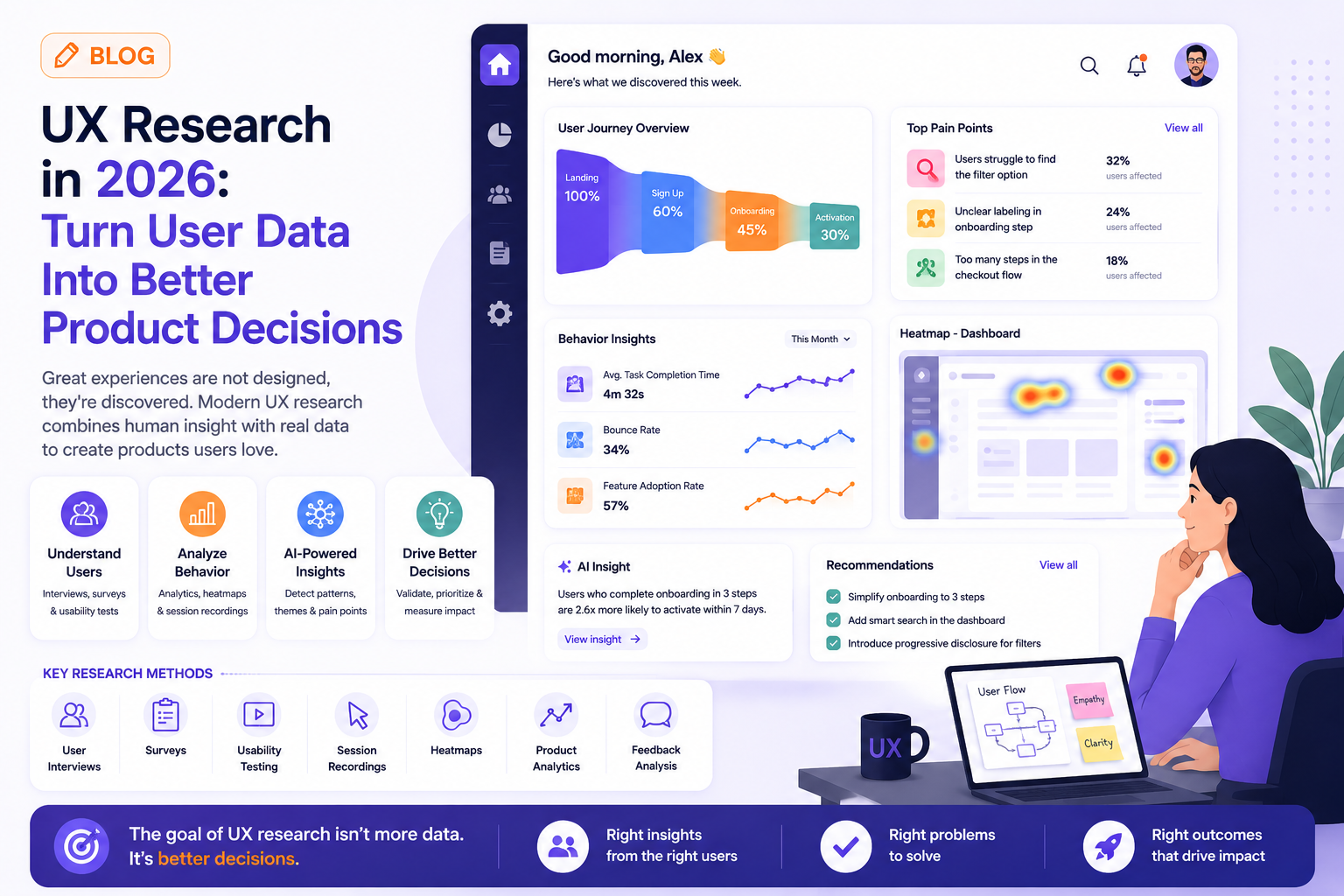
In 2026, UX research is increasingly moving toward a combination of qualitative research, product analytics, usability testing, and AI-assisted analysis.
For enterprise product teams, this creates an opportunity to make UX decisions based on evidence rather than assumptions.
Why Traditional UX Research Is Not Enough
Traditional UX research remains valuable, but enterprise products can generate enormous amounts of behavioral information.
A usability test might reveal that users struggle with a particular workflow.
Product analytics can then show:
- How frequently the problem occurs
- Which user groups experience it
- Where users abandon the workflow
- How long the process takes
- Whether the problem affects business outcomes
Combining these sources provides a much more complete picture.
The goal is not to replace human research with analytics.
It is to understand why something happens and how often it happens.
Start With the Right Research Question
Poor UX research often starts with a vague question:
“Do users like this design?”
A more useful question might be:
“Why are enterprise users taking four steps to complete a task that should require two?”
That question can lead to measurable research.
Teams can investigate:
- User interviews
- Session recordings
- Heatmaps
- Task completion rates
- Search behavior
- Support tickets
- Usability testing
The research becomes connected to a specific product problem.
Combine Qualitative and Quantitative Data
Both forms of research have different strengths.
Quantitative data tells you:
What is happening?
For example:
- 38% of users abandon onboarding
- Search is used by 65% of active users
- A particular workflow takes 7 minutes on average
Qualitative research tells you:
Why is it happening?
Users might explain that:
- A field is difficult to understand
- Navigation is confusing
- They cannot find an important action
- The terminology does not match their business process
The combination produces stronger UX decisions than either method alone.
AI Can Accelerate UX Research
AI can help product teams process large amounts of research material.
Potential applications include:
- Grouping interview responses
- Identifying recurring complaints
- Summarizing usability sessions
- Categorizing support tickets
- Detecting common friction points
- Comparing feedback across user segments
Instead of manually reviewing hundreds of comments, researchers can use AI to identify patterns and then validate those patterns through human analysis.
AI should therefore function as a research accelerator, not the final decision-maker.
Segment Enterprise Users
Enterprise products rarely have one type of user.
A single platform may serve:
- Executives
- Managers
- Administrators
- Analysts
- Operations teams
- Customer-facing employees
Their priorities can be completely different.
A dashboard designed for an executive may prioritize business performance, while an operations user may need detailed workflow information.
UX research should therefore examine users by role rather than treating the entire customer base as one group.
Research the Complete Workflow
Users rarely experience a product one screen at a time.
Their experience often crosses multiple systems.
For example:
Email → Mobile app → Dashboard → Approval system → Notification
A UX problem may not exist inside one interface.
It may exist between interfaces.
Enterprise UX teams should therefore map the complete journey and identify:
- Context switching
- Repeated data entry
- Manual handoffs
- Duplicate notifications
- Unnecessary approvals
- Information gaps
This can uncover opportunities that screen-level usability testing misses.
Accessibility Should Be Part of Research
Accessibility should not be treated as a final compliance review.
Research should include users with different:
- Visual abilities
- Motor abilities
- Cognitive needs
- Device preferences
- Interaction methods
Teams should test keyboard navigation, screen readers, text scaling, contrast, and alternative interaction methods where relevant.
Inclusive research often reveals usability improvements that benefit everyone.
Create a UX Research Repository
Enterprise teams conduct research continuously.
Without a centralized repository, insights can disappear after individual projects.
A research repository can organize:
- Interview findings
- Personas
- Usability results
- Customer feedback
- Journey maps
- Product analytics
- Design experiments
This allows future teams to build on existing knowledge instead of repeatedly researching the same problems.
Turn Research Into Product Decisions
Research has little value if it remains in a presentation.
Teams should connect findings to concrete actions.
For example:
Finding: Users struggle to locate approval requests.
Evidence: High search usage + repeated support requests.
UX change: Add a dedicated approval inbox.
Measurement: Reduce time required to locate and complete approvals.
This creates a clear connection between research and product outcomes.
Industry Perspective
Enterprise product engineering increasingly combines UX research, analytics, AI, and product strategy to create experiences based on real user behavior. Companies such as GeekyAnts have publicly shared work across product engineering and AI-powered solutions, reflecting the broader industry shift toward evidence-driven digital product development.
Conclusion
Modern UX research is becoming less about isolated usability studies and more about understanding the complete relationship between users, workflows, data, and business outcomes.
The strongest enterprise teams combine qualitative research with product analytics, use AI to accelerate analysis, and continuously validate whether design changes actually improve the user’s experience.
The objective is simple:
Research should reduce uncertainty before teams invest heavily in building the wrong experience.