

Enterprise software has traditionally delivered the same experience to every user, regardless of their role, workflow, or preferences. While this standardized approach simplified development, it often resulted in cluttered interfaces, unnecessary complexity, and lower user adoption.
Today, artificial intelligence is changing that paradigm. Organizations are embracing adaptive UX interfaces that adjust dynamically based on user behavior, context, and intent. Instead of expecting users to adapt to software, adaptive UX enables software to adapt to users.
For enterprise leaders driving digital transformation, this shift is becoming a key differentiator in building products that improve productivity, enhance customer experiences, and maximize technology investments.
What Is Adaptive UX?
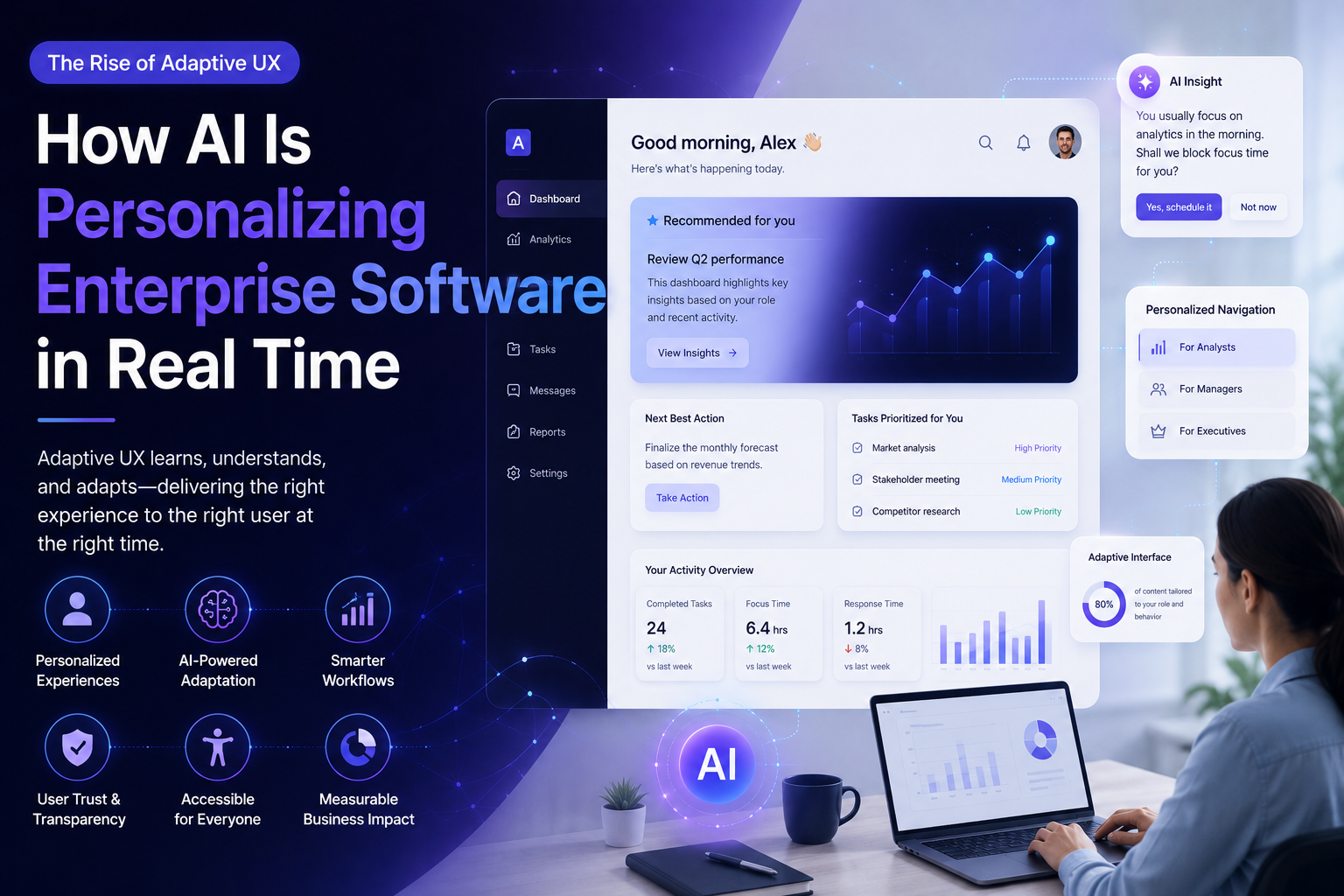
Adaptive UX uses AI, analytics, and contextual data to personalize the user experience in real time. It learns from user interactions and adjusts content, workflows, recommendations, and navigation based on individual needs.
Examples include:
- Personalized dashboards for different user roles
- Context-aware navigation
- AI-powered task recommendations
- Smart search results
- Dynamic onboarding experiences
- Predictive workflow suggestions
Rather than creating one interface for everyone, adaptive UX delivers the right experience to the right user at the right time.
Why Enterprises Are Investing in Adaptive Experiences
Modern enterprises operate across multiple departments, regions, and customer segments. Employees and customers often have different goals, making static interfaces inefficient.
Adaptive UX helps organizations:
- Reduce learning curves
- Increase employee productivity
- Improve customer engagement
- Accelerate task completion
- Simplify complex workflows
- Boost digital adoption
By minimizing unnecessary interactions, businesses create experiences that feel more intuitive and efficient.
AI Is Making Personalization Scalable
Traditional personalization relied on manually defined rules. AI enables applications to recognize patterns, predict user intent, and continuously improve recommendations without requiring constant updates.
For example, an enterprise dashboard can automatically highlight the most relevant reports based on a user’s role and recent activity, while an AI assistant can recommend the next best action during a workflow.
This level of personalization makes enterprise software more proactive and significantly improves usability.
Building Trust Through Transparent Design
Personalized experiences should never come at the cost of user trust.
Enterprise UX teams should ensure users understand:
- Why recommendations are shown
- How AI reaches its conclusions
- What data is being used
- How privacy is protected
- When users can modify or ignore AI suggestions
Transparency strengthens confidence and encourages long-term adoption.
Accessibility Remains a Priority
Adaptive UX should improve accessibility rather than create new barriers.
Organizations should design experiences that support:
- Keyboard navigation
- Screen readers
- High-contrast interfaces
- Voice interactions
- Responsive layouts
- Clear content hierarchy
Inclusive design ensures AI-powered applications remain usable for a diverse workforce.
Measuring the Impact of Adaptive UX
Enterprise leaders increasingly evaluate UX using measurable business outcomes rather than subjective opinions.
Key performance indicators include:
- User adoption rates
- Workflow completion time
- Customer satisfaction
- Employee productivity
- Feature engagement
- Support ticket reduction
- Retention and repeat usage
Monitoring these metrics helps organizations refine digital experiences while demonstrating the business value of UX investments.
Industry Perspective
Across the enterprise technology landscape, product engineering organizations are increasingly integrating UX strategy, AI capabilities, cloud-native architecture, and scalable engineering into unified delivery models. Companies such as GeekyAnts have publicly shared enterprise work across industries including healthcare, fintech, retail, and SaaS, reflecting a broader industry movement toward building intelligent products where personalization and usability are treated as strategic priorities.
Looking Ahead
Adaptive UX will continue to evolve as AI models become more capable of understanding context, predicting user needs, and automating complex interactions. Future enterprise applications will offer increasingly personalized experiences while maintaining transparency, security, and user control.
Organizations that embrace adaptive UX today will be better positioned to deliver software that employees adopt quickly, customers appreciate, and businesses can scale with confidence.
Conclusion
The future of enterprise software is not about adding more features it’s about delivering smarter, more relevant experiences.
By combining AI with user-centered design, adaptive UX helps organizations create digital products that are easier to use, more efficient to navigate, and better aligned with real business goals. As enterprise expectations continue to rise, adaptive UX is set to become a cornerstone of successful digital transformation.