

A digital product can attract thousands of visitors and still struggle to retain users. Often, the problem is not the product’s functionality but the experience users have while discovering, learning, and using it.
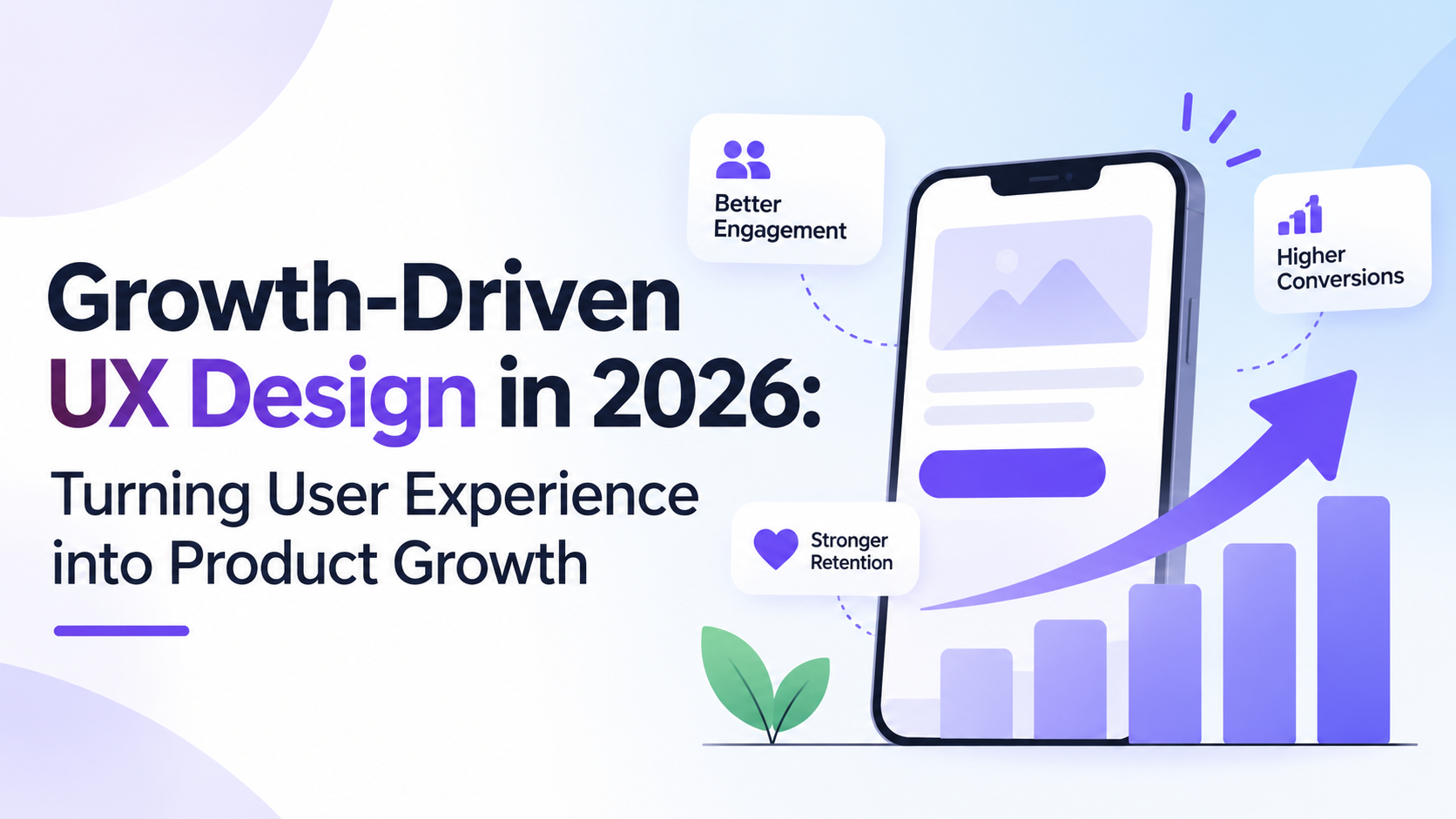
This is why growth-driven UX design is gaining attention in 2026. It connects user experience decisions with measurable product outcomes such as activation, engagement, conversion, and retention.
What Is Growth-Driven UX Design?
Growth-driven UX combines user research, behavioral analytics, usability improvements, and continuous experimentation to help users reach value faster.
Rather than focusing only on visual improvements, designers examine where users struggle and how the experience can be improved.
5 Growth-Driven UX Strategies
1. Design Around the Activation Moment
Identify the first meaningful action that helps users understand a product’s value. Simplify the journey to that moment instead of overwhelming new users with features.
2. Improve Onboarding Experiences
Use contextual guidance, interactive walkthroughs, and personalized onboarding. Give users relevant information when they need it rather than showing every feature at once.
3. Use Behavioral Data
Analyze conversion funnels, user journeys, session behavior, and drop-off points. Combine quantitative analytics with user interviews to understand why users leave.
4. Reduce Friction in Key Journeys
Simplify registration, checkout, navigation, and other important workflows. Remove unnecessary steps and make the next action clear.
5. Experiment and Measure
Test different layouts, calls to action, onboarding flows, and navigation patterns. Measure activation and retention alongside conversion to avoid optimizing one metric at the expense of the overall experience.
Metrics That Matter in Growth UX
Product teams can track:
- Activation rate
- Time to first meaningful value
- Onboarding completion
- Feature adoption
- Conversion rate
- User retention
- Task completion rate
The right metrics depend on the product’s business model and user journey.
The Role of Product Design Teams
Growth-driven UX requires collaboration between designers, product managers, developers, and data teams. Companies such as GeekyAnts work across product design and engineering, where connecting user needs with product outcomes is an important part of building digital experiences.
Final Thoughts
In 2026, UX success is increasingly measured by what users can accomplish, not simply how an interface looks. Businesses that combine research, behavioral insights, and continuous experimentation can create products that are easier to adopt and more valuable over time.