

Enterprise organizations are moving beyond isolated AI experiments. Today, artificial intelligence is being embedded into customer portals, internal platforms, employee tools, and digital products at an unprecedented pace. While AI capabilities continue to evolve, one challenge remains constant—delivering a consistent and intuitive user experience.
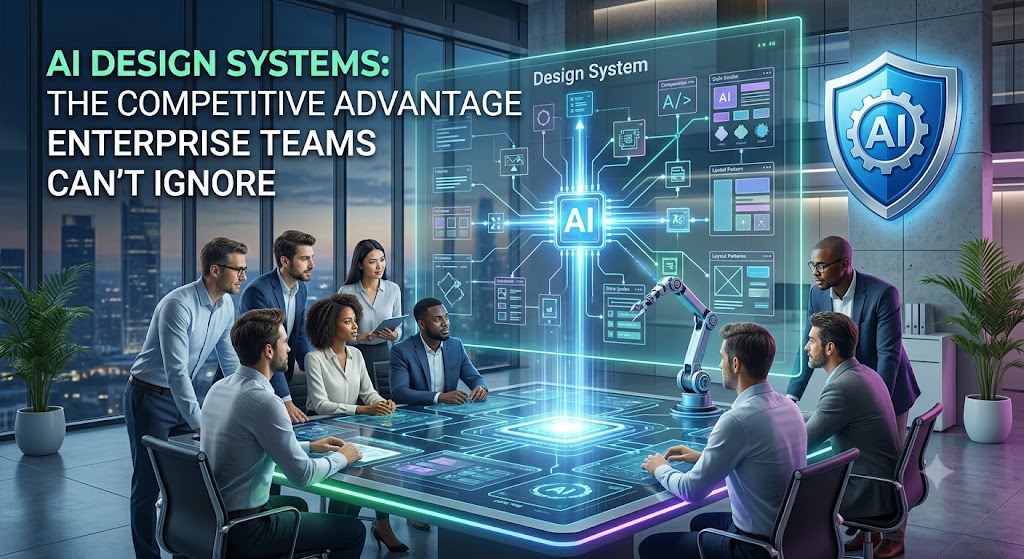
This is where AI design systems are becoming a strategic advantage. Rather than treating AI interactions as standalone features, enterprises are creating standardized design patterns that make intelligent experiences easier to build, scale, and trust.
Why Traditional Design Systems Are No Longer Enough
Design systems have long helped organizations maintain consistency across web and mobile products. However, AI-powered applications introduce new interaction models that traditional component libraries were never designed to support.
Enterprise teams now need standardized patterns for:
- AI assistants and copilots
- Conversational interfaces
- Prompt inputs
- AI-generated recommendations
- Confidence indicators
- Feedback mechanisms
- Human approval workflows
A modern AI design system ensures these experiences remain consistent across every digital touchpoint.
Consistency Builds User Trust
Employees and customers interact with multiple enterprise applications every day. If AI behaves differently in each product, users become hesitant to rely on it.
Consistent interactions help users understand:
- How AI generates recommendations
- When human approval is required
- What information AI uses
- How to provide feedback
- When automated decisions can be overridden
Trust grows when users know what to expect.
Enterprise UX Is Becoming More Collaborative
Creating AI-powered experiences is no longer the responsibility of designers alone.
Successful organizations bring together product managers, UX designers, AI engineers, security teams, and platform architects from the beginning of every project. This collaborative approach helps balance innovation with usability, compliance, and long-term scalability.
When every team contributes early, organizations reduce rework and deliver products that align more closely with business objectives.
Accessibility Must Be Built Into AI Experiences
Accessibility is becoming an essential part of enterprise UX strategy.
AI-powered products should support users with different abilities through clear language, keyboard navigation, readable interfaces, voice interactions, and inclusive design patterns.
Designing for accessibility not only improves compliance but also creates better experiences for every user.
Measuring UX Success
Enterprise leaders increasingly measure UX using business outcomes instead of visual preferences.
Important metrics include:
- User adoption
- Employee productivity
- Customer satisfaction
- Feature engagement
- Workflow completion time
- Support ticket reduction
- Digital adoption rates
These insights help organizations understand whether AI investments are delivering measurable value.
Industry Perspective
Across the enterprise technology landscape, product engineering firms are integrating AI strategy, UX research, cloud engineering, and scalable architecture into unified delivery models. Companies such as GeekyAnts have demonstrated this broader industry direction through enterprise projects spanning healthcare, fintech, retail, and SaaS, where intelligent user experiences are designed alongside robust engineering practices.
Conclusion
AI is changing how enterprise software is built, but its success ultimately depends on how people experience it.
Organizations that invest in AI design systems, accessibility, and user-centered innovation will be better positioned to create trusted digital products, accelerate adoption, and maximize the return on their technology investments.