

Enterprise software is entering a new chapter. Employees no longer want to click through dozens of screens to complete simple tasks. They expect digital products to understand text, voice, images, documents, and context just as naturally as they communicate with colleagues.
This evolution is known as multimodal UX, and it is quickly becoming one of the most important design trends shaping enterprise applications.
For organizations investing in AI, cloud platforms, and digital transformation, multimodal experiences are moving from innovation to expectation.
What Is Multimodal UX?
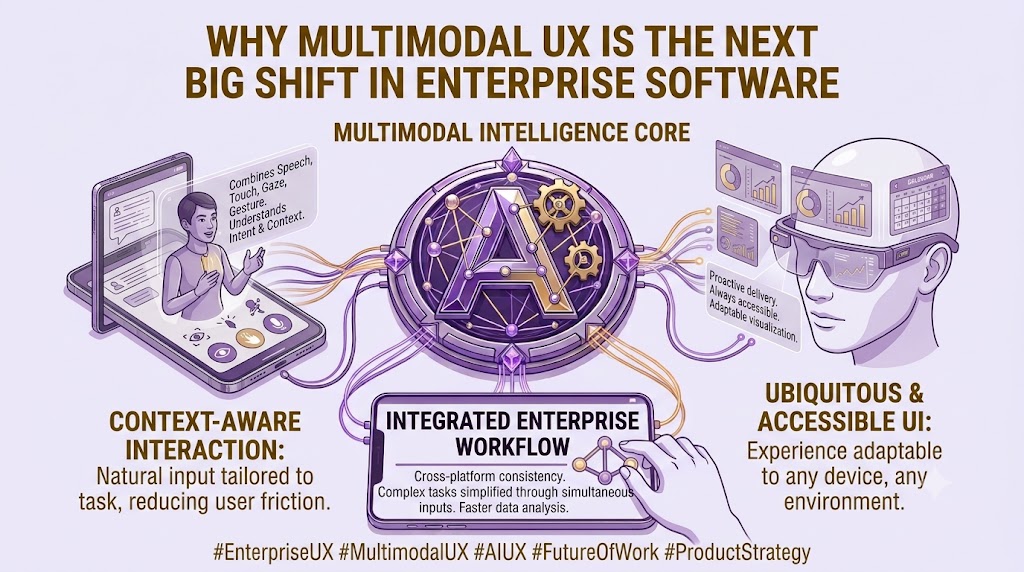
Multimodal UX combines multiple ways of interacting with software, including voice commands, typed prompts, uploaded files, visual inputs, and AI-generated responses.
Instead of forcing users into rigid workflows, enterprise applications can now adapt to how people naturally communicate and solve problems.
Imagine an operations manager uploading a spreadsheet, asking an AI assistant to identify anomalies through voice, and receiving a visual dashboard with actionable recommendations—all within the same interface.
That is the future enterprise users increasingly expect.
Why Enterprises Are Adopting Multimodal Experiences
Enterprise teams work with growing volumes of information every day. Searching through dashboards, switching between applications, and manually analyzing data reduces productivity.
Multimodal UX helps simplify these workflows by allowing users to interact with software in the most efficient way for the task at hand.
Business benefits include:
- Faster decision-making
- Improved employee productivity
- Reduced training requirements
- Better accessibility
- Higher user adoption
- More intuitive AI interactions
Rather than replacing existing workflows, multimodal interfaces make them significantly easier to navigate.
AI Makes Context the New Interface
Traditional enterprise software was designed around menus and navigation structures.
Modern AI-powered applications understand intent.
Instead of searching through dozens of reports, users can simply describe what they need. AI interprets context, retrieves relevant information, and presents results in a format that supports quicker decision-making.
This shift transforms enterprise UX from navigation-driven experiences into conversation-driven experiences.
Designing for Trust
As AI becomes more capable, transparency becomes even more important.
Enterprise UX should clearly communicate:
- Why AI generated a recommendation
- What data influenced the result
- Whether users can modify or reject suggestions
- How automated actions are monitored
Designing explainable experiences builds confidence while supporting governance and compliance initiatives.
Building Scalable Design Systems
Multimodal experiences require design systems that extend beyond buttons and forms.
Organizations now need reusable patterns for conversational interfaces, AI responses, confidence indicators, voice interactions, document previews, and contextual recommendations.
These standards improve consistency while allowing enterprise teams to deliver new AI capabilities faster.
Industry Perspective
Across enterprise product engineering, organizations are increasingly combining UX research, AI engineering, and cloud-native development into unified product strategies. Companies such as GeekyAnts have showcased enterprise work across healthcare, fintech, retail, and SaaS that reflects this broader industry movement toward designing intelligent products where usability and scalability are treated as equal priorities.
Conclusion
The future of enterprise software is not defined by adding more features—it is defined by making technology easier to use.
Multimodal UX enables organizations to create experiences that feel more natural, reduce operational complexity, and increase the value employees and customers receive from digital products.
As AI continues to evolve, enterprises that embrace multimodal design will be better positioned to build software people genuinely enjoy using.