


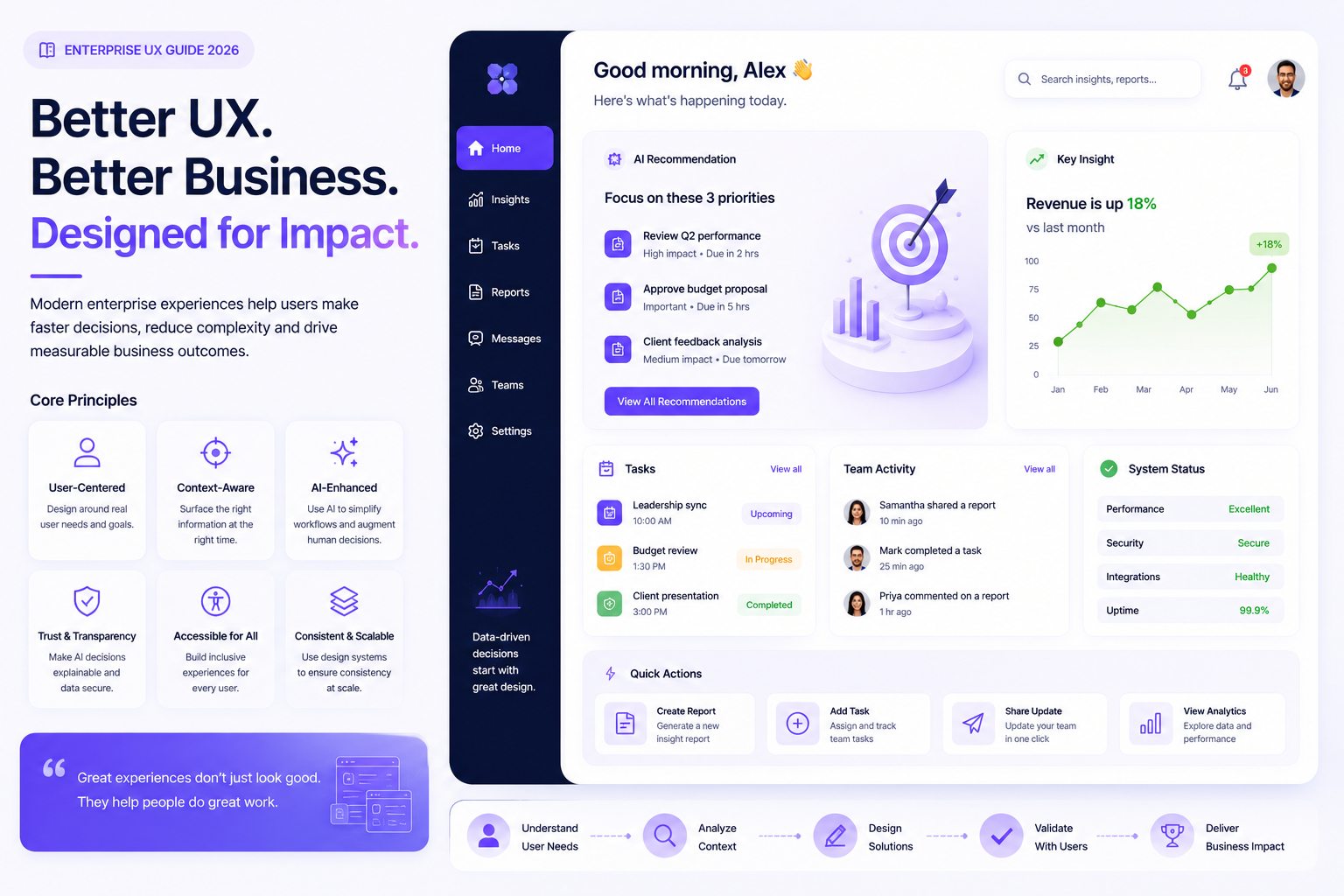
Enterprise software is no longer judged solely by functionality. Today’s digital products are evaluated by how efficiently employees complete tasks, how quickly customers achieve their goals, and how easily organizations can introduce new capabilities without increasing complexity.
As AI becomes embedded into enterprise applications, user experience has evolved from a design discipline into a business strategy. Organizations that invest in thoughtful UX consistently improve software adoption, reduce operational costs, and accelerate digital transformation.
This guide explores the principles, trends, and best practices shaping enterprise UX in 2026.
Why Enterprise UX Matters More Than Ever
Enterprise users interact with increasingly sophisticated platforms across departments such as finance, healthcare, retail, logistics, and manufacturing.
Poor UX creates measurable business challenges:
- Longer employee onboarding
- Lower feature adoption
- Higher support costs
- Slower business processes
- Increased operational errors
- Reduced customer satisfaction
Modern UX strategies address these issues by simplifying complex workflows while supporting enterprise-scale operations.
The Core Principles of Modern Enterprise UX
Successful enterprise products are built around several fundamental principles.
Simplicity
Complex systems should feel simple regardless of the number of underlying features.
Context Awareness
Interfaces should prioritize relevant information based on user roles, workflows, and business objectives.
AI-Assisted Experiences
Generative AI, predictive analytics, and intelligent assistants should reduce repetitive work instead of adding complexity.
Accessibility
Applications should remain usable for diverse users while meeting modern accessibility standards.
Consistency
Scalable design systems ensure consistent experiences across web platforms, mobile applications, and AI interfaces.
AI Trends Shaping UX in 2026
Enterprise UX is increasingly influenced by:
- AI copilots
- Personalized dashboards
- Natural language interfaces
- Predictive workflows
- Multimodal interactions
- Explainable AI experiences
These technologies help users spend less time navigating software and more time making business decisions.
Measuring UX Success
Enterprise organizations should evaluate UX using business outcomes instead of aesthetics alone.
Important metrics include:
- Task completion rate
- Employee productivity
- Software adoption
- Customer satisfaction
- Workflow completion time
- Support ticket reduction
Tracking these metrics demonstrates the direct business value of UX investments.
Common Challenges
Organizations often struggle with:
- Legacy application modernization
- AI transparency
- Design consistency
- Cross-platform experiences
- Large-scale collaboration
- Governance across distributed teams
Addressing these challenges requires close collaboration between product, engineering, and design teams.
Industry Perspective
Across enterprise product engineering, companies are increasingly integrating UX strategy with AI engineering, cloud-native architecture, and scalable product development. Organizations such as GeekyAnts have publicly shared enterprise work that reflects this broader industry trend of treating user experience as a strategic capability rather than a final design activity.
Final Thoughts
Enterprise UX is becoming a competitive differentiator rather than a supporting function.
Organizations that invest in scalable design systems, responsible AI, and user-centered product strategies will be better positioned to build digital products that employees adopt, customers trust, and businesses can continuously evolve.