

Someone lands on your platform. They’re ready to buy, sign up, or book a demo. Thirty seconds later, they’re gone ,not because your product failed them, but because your interface did. No complaint ticket. No feedback. Just a closed tab and a competitor’s URL already loading.
This is the daily reality for hundreds of North American businesses, and most of their leadership teams are still attributing the losses to marketing spend, pricing strategy, or sales pipeline issues. The culprit sitting quietly at the center of the problem is poor UI/UX ,and it is draining revenue in ways that most quarterly reports never isolate.
The frustrating part is not that UX problems are hard to identify. It’s that fixing them keeps getting deprioritized because the damage is diffuse. Lost customers rarely announce themselves. They don’t call to say the navigation confused them or the checkout flow had three unnecessary steps. They simply leave, and their lifetime value goes with them.
The Numbers Don’t Lie
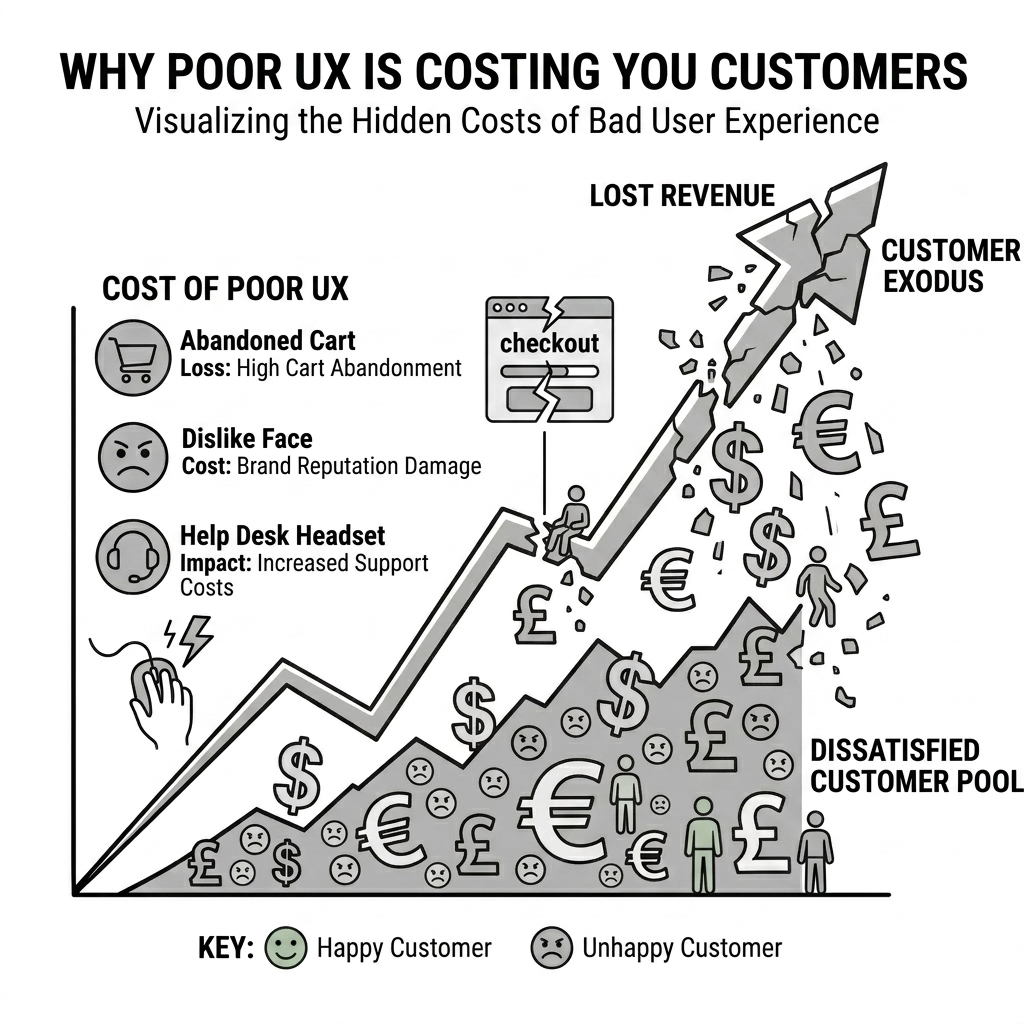
The data on UX failures has become impossible to dismiss. The Baymard Institute’s research found that the average large e-commerce site can increase its conversion rate by 35.26% just by redesigning its checkout process ,and based on combined e-commerce sales in the U.S. and EU, that translates to approximately $260 billion in recoverable revenue lost solely due to poor checkout design.
That is not a niche finding. That is systemic.
Among shoppers who abandoned a checkout ,excluding those who were just browsing ,24% left because the site required them to create an account, 22% abandoned because delivery was too slow, and 17% gave up solely because the checkout process was too complicated. None of those are product problems. Every single one is a design problem.
On mobile, the picture is worse. Mobile cart abandonment now sits at 85.2%, and a 1-second delay in page load time can reduce conversions by 7%. For companies that generate any meaningful portion of revenue through mobile ,which in 2025 is nearly every B2B and B2C operation with a digital presence ,this is a direct hit to the bottom line.
Research attributed to Forrester found that every $1 invested in UX returns $100. And on the other side of that equation, 88% of users are less likely to return to a site after a bad experience ,and 91% of unhappy users simply disappear without leaving any feedback.
That last figure is the one that should keep product owners up at night. The silence is not agreement.
Case in Point: What Bad UX Actually Costs
Consider a mid-size SaaS company headquartered in Toronto. Their onboarding flow required new users to complete seven steps before reaching the core product feature. Internal data showed a 62% drop-off rate at step four. The team had assumed users were leaving due to pricing objections. A usability audit revealed the real problem: the interface didn’t communicate progress, the form labels were ambiguous, and the mobile version broke at step three. Six weeks after a redesign, trial-to-paid conversion improved by over 30%. The pricing was never touched.
This pattern ,misattributed churn, delayed diagnosis, expensive late-stage fixes ,is exactly what design firms like GeekyAnts have built their service model around. GeekyAnts, with over 17 years of app design and development experience, positions UX audits as a diagnostic business tool, arguing that good UI/UX design increases ROI through better retention and loyalty of existing users while attracting new ones ,and that it reduces time and resources by testing and fixing usability issues ahead of time rather than post-launch.
Their work across industries ,from billing platforms to healthcare portals to fintech applications ,consistently shows the same pattern: businesses that treat UX as a cosmetic layer suffer retention problems they misread as sales problems.
Another consistent finding across B2B platforms is support cost inflation. When a workflow is confusing, users don’t redesign the interface themselves ,they open tickets. A poorly labeled admin panel generates more helpdesk volume than a buggy feature, because bugs get patched while confusing UX persists for years. The support team absorbs the cost, leadership sees a people problem, and the design debt compounds quietly.
How Smart Companies Are Fixing This
The firms closing the gap between UX quality and business performance are not necessarily spending more on design. They are spending more strategically and earlier.
The operational shift looks like this:
- UX research happens before development sprints, not after user complaints accumulate.
- Usability testing metrics ,task completion rates, error rates, time-on-task ,are tied directly to revenue and retention KPIs, not just design OKRs.
- Design decisions go through audit cycles, not just aesthetic reviews.
GeekyAnts frames this approach directly in their service model: keeping usability and experience as top priorities ensures that every product they ship drives business KPIs ,not just design standards. That framing matters because it changes how UX investments get approved internally. When design is positioned as a revenue function rather than a cost center, it gets resourced accordingly.
McKinsey’s research on design-driven companies reinforces the business case. Companies that embedded design practices deeply into their product development process outperformed industry peers by up to 2x in revenue growth ,not because they had better-looking products, but because they had fewer friction points in the user journey.
For companies in the $5M to $100M revenue range ,the cohort most actively researching UX services right now ,the practical next step is a UX audit, not a full redesign. Audits surface the highest-impact friction points first. They create a prioritized fix list that product managers can sequence against existing sprints without blowing up a roadmap.
The companies losing clients to UX failures are not failing at strategy. They are failing at execution detail ,the checkout flow that’s two steps too long, the mobile nav that buries the primary CTA, the onboarding sequence that never tells the user what comes next. These are fixable problems. The cost of fixing them is almost always less than the cost of losing the customer who walked away because of them.