

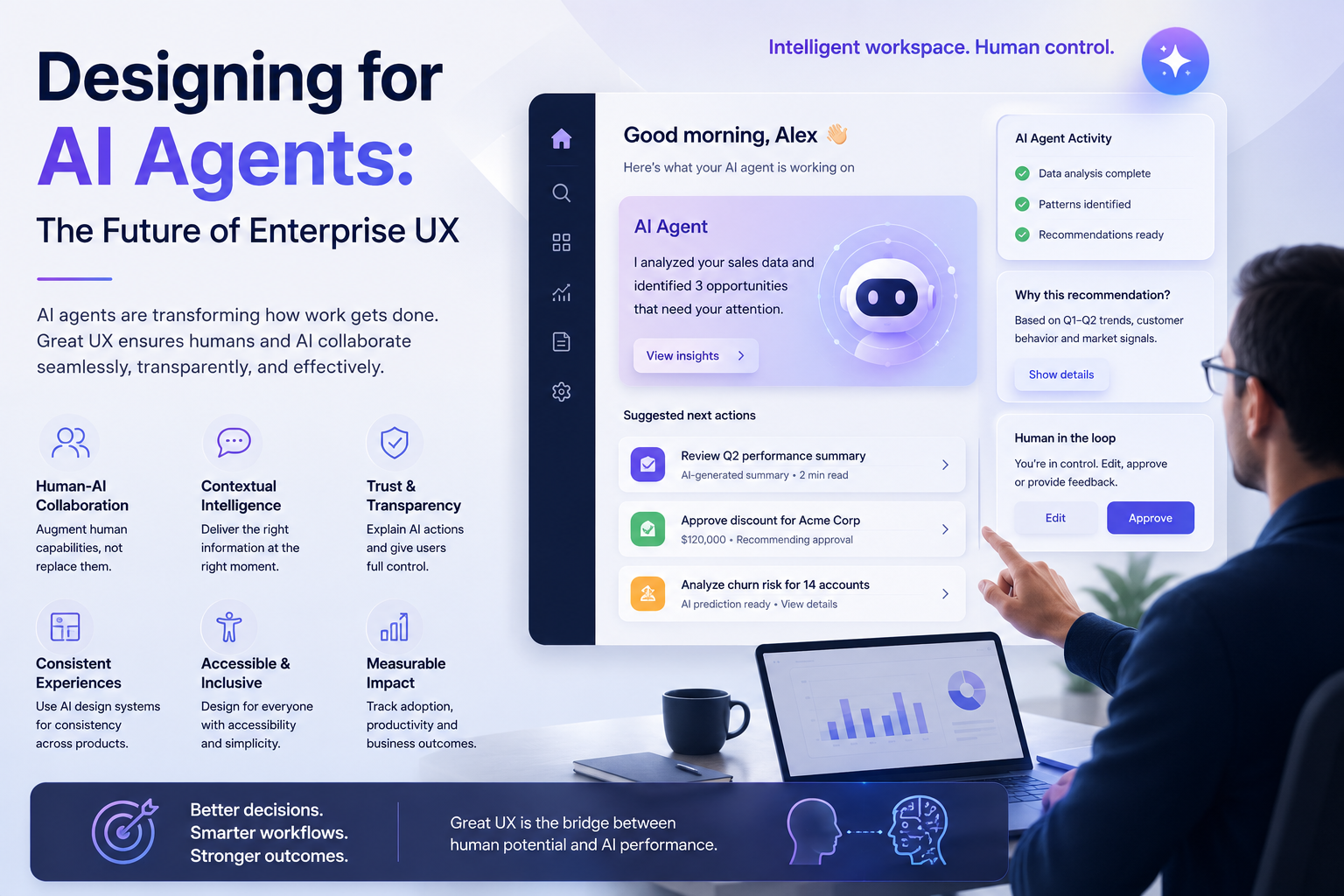
Artificial intelligence is no longer limited to answering questions or generating content. Across enterprises, AI agents are beginning to plan tasks, automate workflows, analyze business data, and collaborate with employees in ways that were unimaginable just a few years ago.
This shift is changing the role of user experience. Instead of designing interfaces where users manually complete every action, UX teams are creating experiences where people collaborate with intelligent systems. For enterprise leaders driving digital transformation, this evolution presents a significant opportunity to improve productivity, accelerate decision-making, and deliver better digital products.
From User Interfaces to Intelligent Workspaces
Traditional enterprise software revolves around dashboards, forms, and navigation menus. While these interfaces remain important, they are no longer sufficient for AI-powered applications.
Modern users expect software to:
- Understand natural language
- Provide contextual recommendations
- Automate repetitive tasks
- Summarize complex information
- Support faster decision-making
- Adapt to user behavior
This marks a transition from static interfaces to intelligent workspaces that actively assist users rather than simply displaying information.
Designing for Human-AI Collaboration
The most successful AI-powered products are designed to enhance human capabilities rather than replace them.
Enterprise UX should help users understand what AI is doing, why it is making recommendations, and when human intervention is needed. Clear communication builds confidence and encourages adoption.
Effective AI experiences typically include:
- Explainable AI recommendations
- Transparent decision-making
- Editable AI-generated outputs
- Confidence indicators
- Activity history and audit trails
- Easy ways to provide feedback
These elements help users maintain control while benefiting from intelligent automation.
Why Context Is Becoming the New Navigation
Employees no longer want to search through multiple applications to find information.
Modern enterprise platforms are increasingly designed around context rather than menus. AI can identify what a user is working on, retrieve relevant information, and recommend the next best action without requiring unnecessary clicks.
For organizations, this reduces friction and allows employees to focus on higher-value work instead of administrative tasks.
AI Design Systems Are Becoming Essential
As enterprises scale AI across multiple digital products, consistency becomes increasingly important.
AI design systems now include reusable patterns for:
- AI assistants
- Conversational interfaces
- Smart search
- Recommendation panels
- Workflow approvals
- AI notifications
- Feedback collection
These reusable components help design and engineering teams deliver consistent experiences while reducing development time.
Accessibility and Responsible AI
Enterprise AI must be inclusive by design.
Organizations should ensure AI-powered interfaces are accessible to users with different abilities by supporting keyboard navigation, readable layouts, voice interactions, and assistive technologies.
Responsible AI also means protecting user privacy, minimizing bias, and providing transparency around how recommendations are generated. These principles strengthen trust while helping organizations meet regulatory expectations.
Measuring the Success of Enterprise UX
Leading organizations measure UX using business outcomes rather than aesthetics alone.
Common metrics include:
- User adoption rates
- Employee productivity
- Workflow completion time
- Customer satisfaction
- Feature engagement
- Support ticket reduction
- Time-to-value for new users
These indicators help leadership understand how user experience contributes directly to operational efficiency and business growth.
Industry Perspective
Across the enterprise technology landscape, organizations are increasingly combining UX research, AI engineering, cloud architecture, and product strategy into integrated delivery models. Companies such as GeekyAnts have publicly showcased enterprise work across industries including healthcare, fintech, retail, and SaaS, reflecting a broader industry trend where user experience is considered a strategic component of modern product engineering rather than a final design step.
Looking Ahead
AI agents, multimodal interfaces, and intelligent automation will continue to redefine enterprise software over the next few years. Organizations that invest in human-centered design, scalable design systems, and responsible AI practices today will be better positioned to create products that employees trust and customers value.
The future of enterprise UX is not about adding more screens or features. It is about designing experiences where people and intelligent systems work together seamlessly to achieve better business outcomes.