

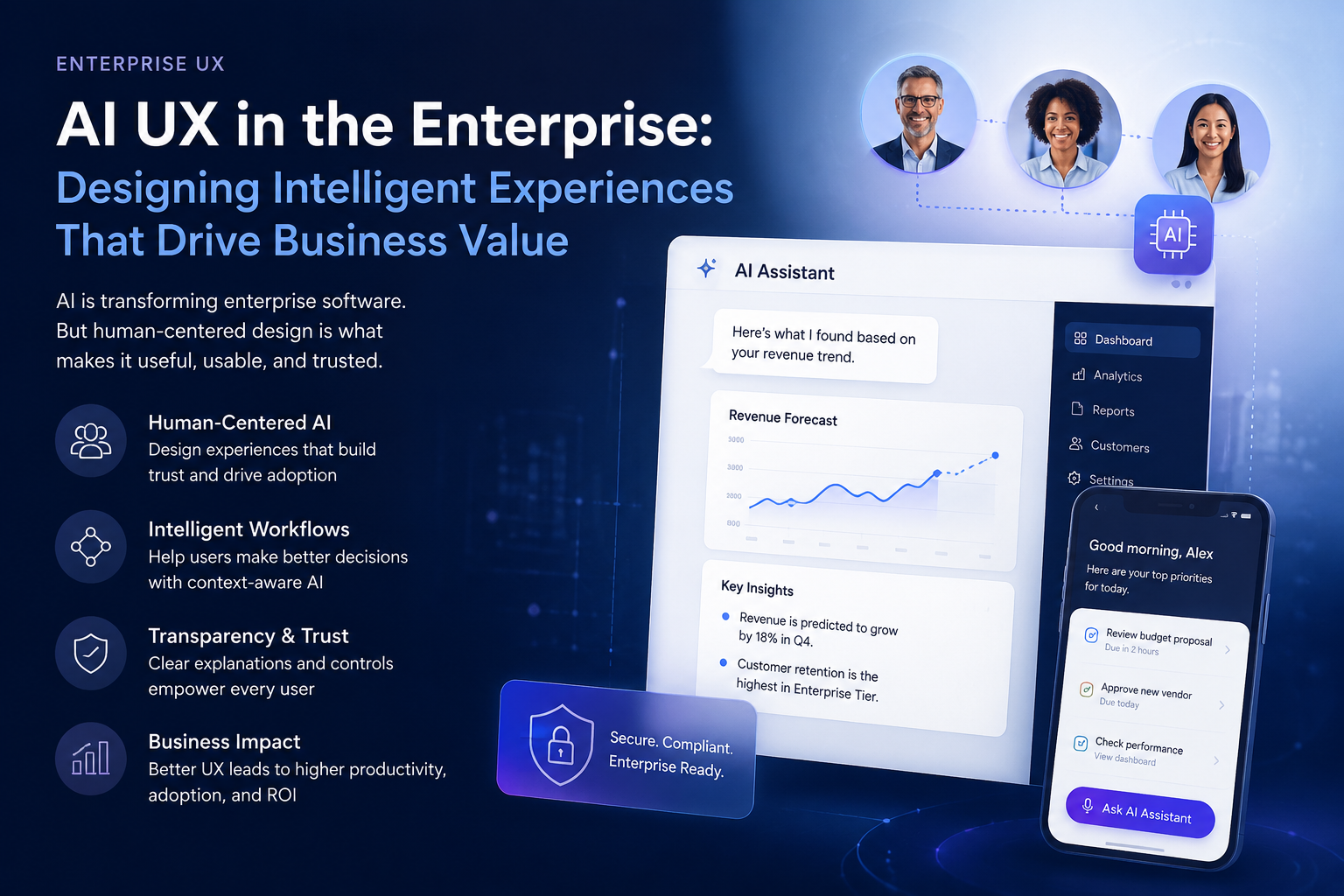
Artificial intelligence is reshaping enterprise software, but success depends on more than advanced algorithms. As organizations integrate AI into customer portals, internal platforms, and mobile applications, user experience (UX) has become a critical factor in determining whether these investments deliver measurable business value.
For enterprise leaders, the goal is no longer just to build AI-powered products—it is to create intuitive, trustworthy, and efficient experiences that employees and customers actually use.
Why Enterprise UX Matters in the AI Era
Enterprise applications are becoming increasingly complex, often combining AI assistants, analytics dashboards, automation tools, and cloud-based workflows. Without thoughtful UX, even the most advanced technology can overwhelm users, slow adoption, and increase support costs.
A strong UX strategy helps organizations:
- Improve employee productivity
- Increase customer satisfaction
- Reduce training and onboarding time
- Accelerate digital transformation
- Maximize the return on AI investments
In enterprise environments, user experience directly influences business outcomes.
Designing AI That Users Trust
Trust is one of the biggest challenges in AI adoption. Users need to understand how AI-generated recommendations are made and feel confident that they remain in control.
Good AI UX includes:
- Clear explanations for AI suggestions
- Human oversight for critical decisions
- Transparent workflows
- Consistent interactions across platforms
- Accessible and inclusive design
When AI is predictable and easy to understand, users are more likely to adopt it in their daily workflows.
The Role of Design Systems
As enterprises manage multiple products and teams, design systems have become essential. They provide reusable components, accessibility standards, and consistent interaction patterns that improve collaboration between design and engineering teams.
This consistency reduces development effort while delivering a familiar experience across web, mobile, and internal applications.
Collaboration Drives Better Products
Building enterprise AI products requires close collaboration between product managers, designers, engineers, and data teams. Organizations that involve UX from the early stages of product development often identify usability issues before they become costly engineering challenges.
Rather than treating design as a final step, leading enterprises integrate UX throughout the entire product lifecycle.
Industry Perspective
Across the product engineering industry, there is a growing emphasis on combining AI expertise with user-centered design. Companies such as GeekyAnts have highlighted projects in healthcare, fintech, retail, and enterprise SaaS that demonstrate how design, engineering, and AI can work together to create scalable digital products. This reflects a broader industry shift toward building intelligent applications that prioritize both technical excellence and user adoption.
Looking Ahead
As AI continues to evolve, enterprise software will become more conversational, personalized, and predictive. Organizations that invest in intuitive user experiences alongside AI capabilities will be better positioned to improve adoption, streamline operations, and deliver long-term business value.
Conclusion
AI is transforming how enterprises build digital products, but technology alone is not enough. A well-designed user experience ensures that AI enhances productivity rather than adding complexity. By combining thoughtful UX, responsible AI practices, and strong engineering, organizations can create enterprise applications that are both powerful and easy to use, helping them stay competitive in an increasingly digital landscape.