

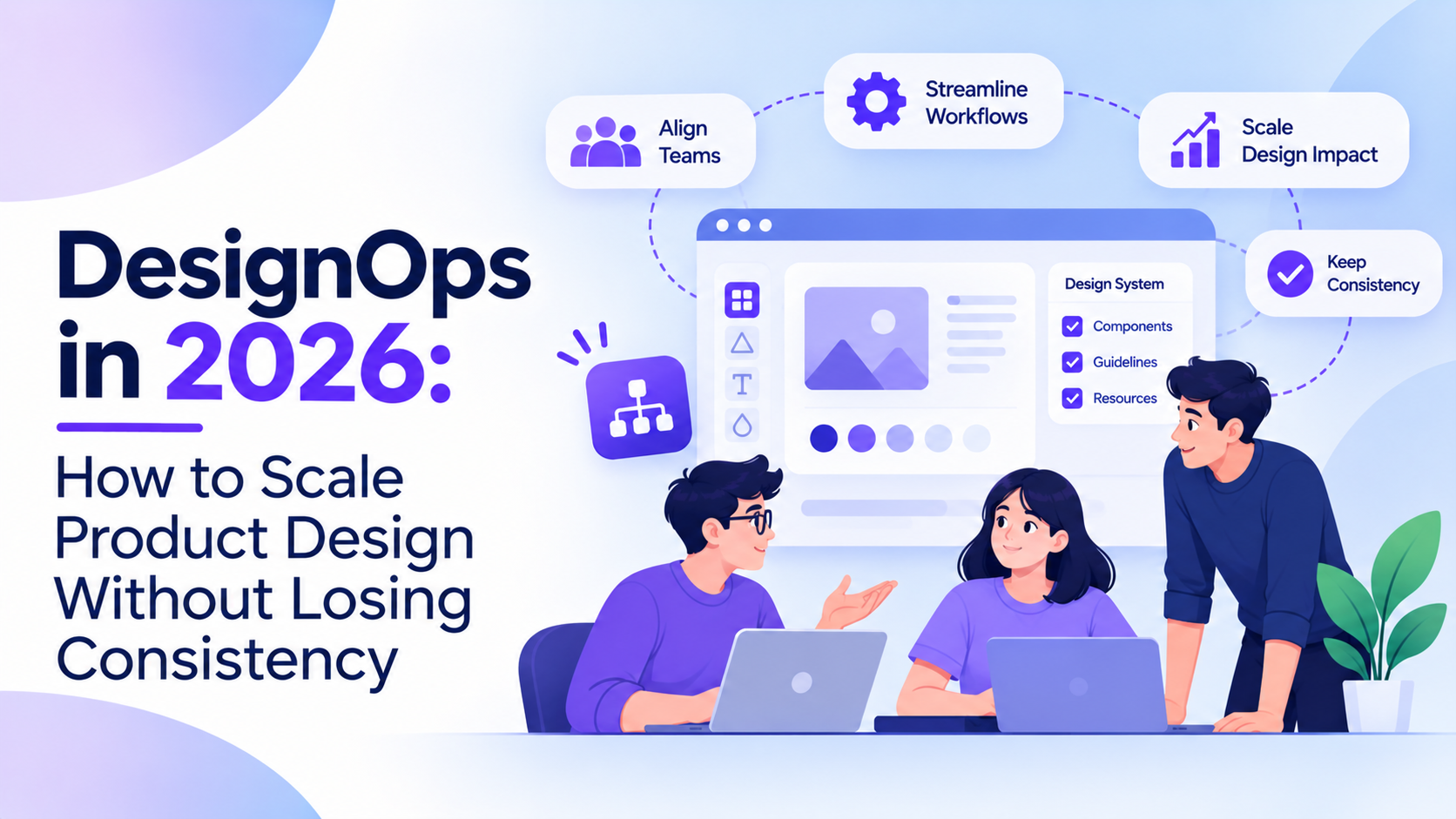
As digital products grow, design teams face an increasingly complex challenge: maintaining consistent user experiences across multiple products, platforms, and development teams.
A company may have several designers working on different features, multiple engineering teams implementing interfaces, and product managers handling separate roadmaps. Without shared processes, design inconsistencies, duplicated work, and communication gaps can slow product development.
This is where DesignOps becomes important. It helps organizations improve how design teams collaborate, manage workflows, and deliver consistent product experiences at scale.
What Is DesignOps?
DesignOps, or Design Operations, refers to the processes, tools, systems, and collaboration practices that help design teams work more effectively.
It connects UX research, product design, design systems, product management, and engineering. Rather than focusing only on the final interface, DesignOps improves the entire design workflow—from research and planning to implementation and continuous improvement.
Why DesignOps Is Becoming Important in 2026
Product teams are working with faster development cycles, AI-assisted design tools, distributed teams, and increasingly complex digital experiences.
These changes create new operational challenges:
- Designers need to collaborate across multiple product teams.
- Developers need consistent and implementation-ready design specifications.
- Design systems require regular maintenance.
- AI-generated design concepts need quality and accessibility reviews.
- Product organizations need measurable design outcomes.
DesignOps provides a structured approach to addressing these challenges without limiting creative exploration.
6 DesignOps Practices for Modern Product Teams
1. Build and Maintain a Shared Design System
A design system provides reusable components, typography, color tokens, spacing rules, and interaction patterns.
It helps teams avoid creating the same elements repeatedly and ensures that users experience consistent interfaces across products.
However, creating a design system is only the beginning. Teams also need ownership, documentation, version control, and a clear process for introducing changes.
2. Improve Design-to-Development Collaboration
Design handoffs often create unnecessary delays when specifications are incomplete or developers interpret interactions differently.
Teams can improve collaboration through interactive prototypes, component documentation, clear responsive behavior, and regular design-engineering reviews.
Bringing developers into design discussions earlier can also reveal technical limitations before implementation begins.
3. Establish Design Governance
As design systems expand, organizations need clear rules for maintaining quality.
Design governance defines component ownership, accessibility requirements, review processes, and approval guidelines.
For example, an enterprise product team may require shared navigation components to follow common usability standards while allowing individual product teams flexibility in their workflows.
4. Introduce AI-Assisted Design Workflows
AI tools can support repetitive design activities such as generating initial wireframes, exploring layout variations, summarizing research feedback, and documenting components.
However, AI-generated designs should not automatically become production-ready interfaces. Designers still need to evaluate usability, accessibility, brand consistency, and actual user needs.
The best approach is to use AI to accelerate exploration while keeping design decisions grounded in research.
5. Improve UX Research Operations
Research findings often become fragmented across documents, teams, and projects.
Centralized research repositories, consistent documentation, and reusable insights help designers avoid repeating earlier investigations.
Teams can also connect qualitative research with product analytics to understand both what users do and why they behave in particular ways.
6. Measure Design Operations
DesignOps should produce measurable improvements rather than simply introduce more processes.
Useful indicators include:
- Design system adoption and component reuse.
- Time required for design-to-development handoffs.
- Number of duplicated design components.
- Accessibility and usability issues identified.
- Design review turnaround time.
- User satisfaction and task completion.
These measurements help teams understand whether their design operations are actually improving product delivery.
Common DesignOps Challenges
Implementing DesignOps can create challenges of its own. Too many approval steps may slow down creative work, while overly rigid design systems can prevent teams from addressing unique user requirements.
Organizations should avoid treating DesignOps as additional bureaucracy.
Instead, processes should be proportional to team size, product complexity, and business needs. A small product team may need only a shared component library and regular reviews, while a large enterprise may require dedicated design system ownership and governance.
Why DesignOps Matters for Enterprise Products
Enterprise platforms often involve several teams building dashboards, customer portals, internal tools, and mobile applications simultaneously.
Without shared design practices, users may encounter different navigation patterns, inconsistent components, and confusing workflows across the same organization’s products.
DesignOps creates a foundation for consistency while allowing individual teams to solve specific product problems.
Product design and engineering companies such as GeekyAnts work across these disciplines, where coordination between UX, design systems, and implementation is important.
Final Thoughts
DesignOps is not about restricting creativity or making every interface look identical. It is about creating the operational foundation that allows design teams to collaborate, experiment, and scale without compromising usability.
As digital products become more complex, organizations that invest in design operations can improve collaboration, reduce duplicated effort, and deliver more consistent product experiences.