

Artificial intelligence is transforming enterprise software, but users aren’t looking for more buttons, dashboards, or complicated workflows. They want technology that helps them accomplish tasks without getting in the way.
This shift is driving a new design philosophy known as Invisible UX creating experiences where AI quietly supports users by anticipating needs, simplifying decisions, and automating repetitive actions. Instead of demanding constant interaction, the interface fades into the background while productivity takes centre stage.
For enterprise organisations investing in AI and digital transformation, Invisible UX is becoming a defining characteristic of successful digital products.
What Is Invisible UX?
Invisible UX focuses on reducing cognitive effort rather than adding visual complexity.
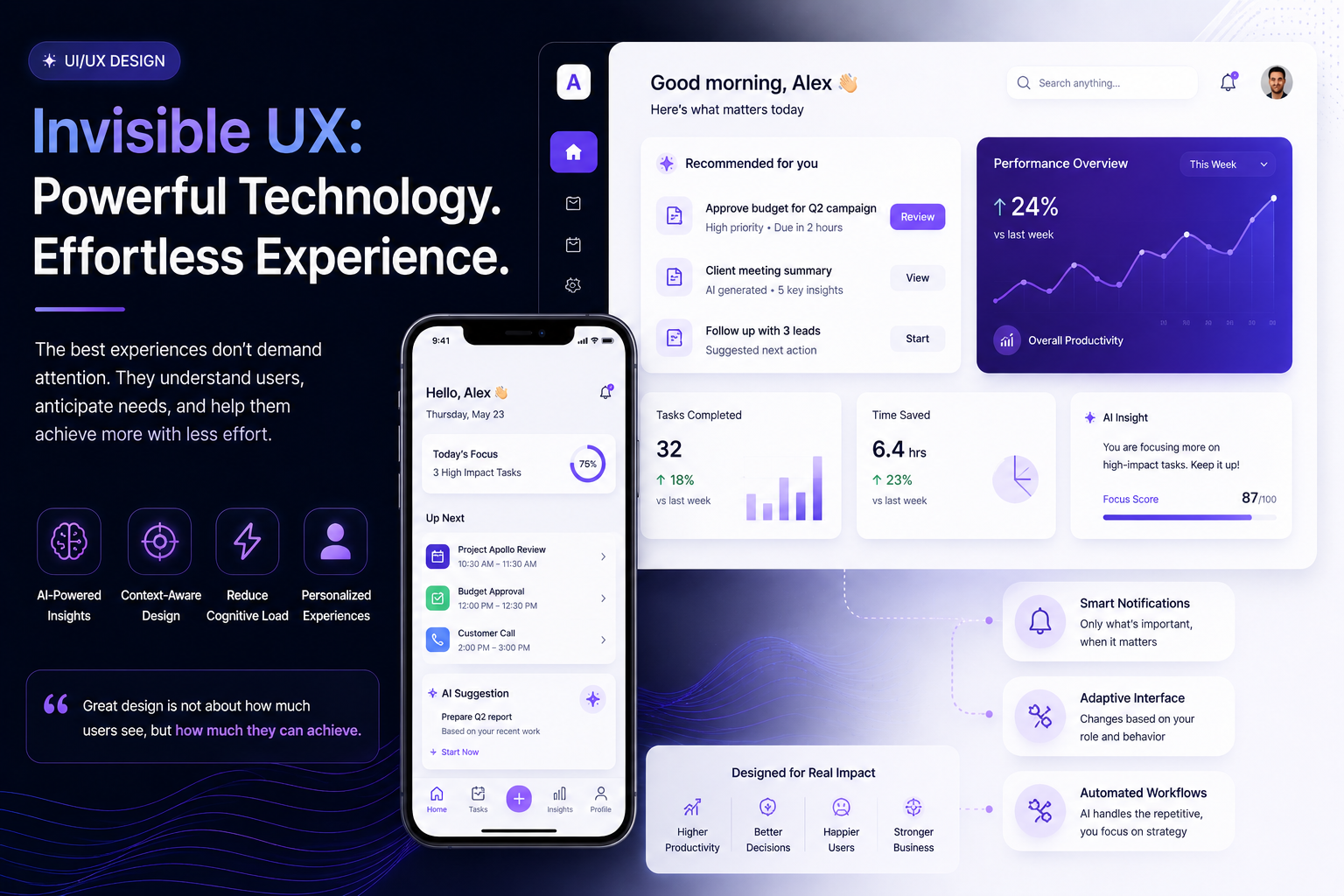
Instead of requiring users to search for information or navigate multiple screens, AI understands context and presents relevant actions when they are needed.
Examples include:
- Smart task prioritisation
- AI-generated summaries
- Context-aware recommendations
- Automatic workflow suggestions
- Intelligent notifications
- Adaptive navigation
The objective is simple: allow users to focus on outcomes rather than software.
Why Simplicity Wins
Enterprise platforms often become more complex as organisations grow.
Employees spend valuable time switching between systems, locating information, and completing repetitive processes. Every additional click adds friction.
Invisible UX helps organisations:
- Improve productivity
- Reduce training time
- Increase software adoption
- Accelerate decision-making
- Reduce user errors
- Improve employee satisfaction
The less effort users spend navigating software, the more time they spend solving business problems.
AI Enables Context-Driven Design
Modern AI can analyse user behaviour, role, previous activity, and business priorities to provide highly relevant experiences.
Instead of presenting the same dashboard to everyone, enterprise applications can highlight the most important information for each individual user.
This creates experiences that feel personalised without requiring manual configuration.
Transparency Builds Confidence
Invisible UX should never become invisible decision-making.
Enterprise applications should clearly communicate:
- Why recommendations appear
- Which data influenced AI outputs
- How users can override suggestions
- What actions AI has completed automatically
Giving users visibility and control strengthens trust while supporting responsible AI adoption.
Designing for Enterprise Scale
Invisible UX must remain consistent across web applications, mobile platforms, internal tools, and customer-facing products.
Scalable design systems help organisations maintain consistency while introducing new AI capabilities across multiple teams and products.
Industry Perspective
Across enterprise product engineering, organisations are increasingly integrating UX research, AI engineering, cloud-native architecture, and product strategy into unified delivery models. Companies such as GeekyAnts have publicly shared enterprise work across healthcare, fintech, retail, and SaaS, reflecting a broader industry movement towards building intelligent products that prioritise usability alongside technical excellence.
Conclusion
The future of UX is not about adding more interfaces it is about making technology feel effortless.
Organisations that embrace Invisible UX will create enterprise software that is faster to learn, easier to trust, and more valuable for employees and customers alike.