Choosing a UI/UX design agency can influence how customers interact with your website, mobile application, or digital product. A well-designed interface can make information easier to understand, simplify important tasks, and help users navigate a product with confidence.
However, selecting an agency based only on attractive portfolio images can be misleading. A polished interface does not necessarily demonstrate that the team understands user behavior, solves usability problems, or can support a product as it grows.
The right agency should combine design expertise with research, usability testing, business understanding, and collaboration with developers. This guide explains how to evaluate potential partners, compare proposals, and identify a UI/UX design agency that fits your project.
What Does a UI/UX Design Agency Do?
A UI/UX design agency helps businesses research, plan, design, and validate digital experiences.
User experience (UX) design focuses on how people interact with a product, including navigation, information architecture, user flows, usability, and task completion.
User interface (UI) design focuses on the visual and interactive elements users encounter, including typography, colors, buttons, layouts, and components.
Depending on the engagement, an agency may provide:
- User research and competitor analysis.
- User personas and journey mapping.
- Information architecture and wireframing.
- Interactive prototypes.
- Website and mobile app UI design.
- Design systems and reusable components.
- Accessibility reviews and usability testing.
- Developer handoff and design quality assurance.
Some agencies specialize in research and interface design, while others offer product strategy and development as well. Understanding the difference helps you compare providers more accurately.
8 Factors to Consider When Choosing a UI/UX Design Agency
1. Review the Portfolio Beyond Visual Appeal
A portfolio is a useful starting point, but the quality of the final screens is only one part of the evaluation.
Look for case studies that explain the original problem, the intended audience, the design decisions, and the outcome. A strong case study should help you understand why the agency chose a particular solution rather than simply showing attractive mockups.
Check whether the agency has experience with products similar to yours, such as SaaS dashboards, ecommerce websites, enterprise platforms, healthcare applications, or financial products.
Ask who contributed to each project and what responsibilities the agency handled.
2. Evaluate the UX Research Process
Effective design begins with understanding users and their needs.
Ask how the agency conducts research and determines which usability problems deserve attention. Depending on your product, relevant methods may include stakeholder interviews, user interviews, surveys, analytics reviews, usability testing, and competitor analysis.
Not every project requires extensive research. A focused website improvement may need a lighter process than a complex enterprise platform. The agency should explain how its research approach fits your project’s risks and scope.
3. Understand the Design Process
A clear design process reduces confusion and helps stakeholders make informed decisions.
Ask how the agency moves from discovery to user flows, wireframes, visual design, prototyping, testing, and final handoff.
Find out how often you will review work, how feedback will be incorporated, and who approves major decisions.
A reliable agency should be able to explain its process in practical terms rather than relying on vague promises about creativity or innovation.
4. Check Industry and Product Experience
Different products introduce different design challenges.
An ecommerce platform may require better product discovery and checkout flows. A fintech application may need clear transaction states, understandable error messages, and interfaces that support user confidence. An enterprise dashboard may need to present complex information without overwhelming users.
Industry experience can shorten the learning process, but it should not be the only selection criterion. Look for evidence that the agency can understand unfamiliar problems and adapt its methods to your users.
5. Ask About Usability Testing and Accessibility
Design decisions should be validated rather than based entirely on assumptions.
Ask whether the agency tests prototypes with representative users, how it identifies usability issues, and how findings influence later iterations.
Accessibility should also be considered throughout the project. Discuss keyboard navigation, text contrast, form labels, screen-reader support, and relevant WCAG requirements.
An agency should be able to explain how it identifies and addresses usability and accessibility issues before the product reaches users.
6. Review Design Systems and Developer Handoff
For products with many screens or frequent updates, a design system can improve consistency and reduce duplicated effort.
Ask whether the agency will create reusable components, document design tokens, define component states, and provide responsive layout specifications.
Developer handoff should include the information needed to implement the design accurately. Clarify how the agency will handle questions from engineers and whether it will review the implemented interface for visual and interaction differences.
7. Compare Pricing, Scope, and Deliverables
UI/UX design pricing varies according to project complexity, research requirements, team experience, and the number of screens and user flows.
Before comparing quotes, confirm what each proposal includes.
| Deliverable | Questions to ask |
|---|---|
| Discovery and research | How much research is included? |
| Wireframes | Which user flows and screens are covered? |
| UI design | Are responsive layouts and interaction states included? |
| Prototypes | Will the prototype support realistic user testing? |
| Design system | Are reusable components and documentation included? |
| Handoff | What specifications and assets will developers receive? |
| Revisions | How many feedback rounds are included? |
| Post-handoff support | Is implementation review included or billed separately? |
The lowest quote may exclude important activities that are necessary for a successful project. Compare scope and expected outcomes, not just the total price.
8. Assess Communication and Team Fit
Even a capable agency can struggle if communication is inconsistent or responsibilities are unclear.
Find out who will lead the project, who will perform the design work, and whether the senior designers involved in the initial discussions will remain engaged.
Discuss meeting schedules, project documentation, feedback timelines, escalation procedures, and collaboration tools.
A good partner should also be willing to challenge assumptions respectfully when a proposed design decision may create usability problems.
Questions to Ask Before Hiring a UI/UX Design Agency
Use these questions during an introductory call or proposal review:
- Have you worked on products with similar users and business goals?
- How do you identify the most important UX problems?
- What research and testing will this project require?
- How do you measure whether a design solution is effective?
- Who will work on the project, and what are their responsibilities?
- What deliverables will we receive at each stage?
- How do you collaborate with our development team?
- How do you approach accessibility and responsive design?
- What is excluded from the proposal?
- Who owns the final design files, assets, and documentation?
- Clear answers make it easier to compare agencies on consistent criteria.
Red Flags to Watch For
Be cautious if an agency:
- Shows only polished mockups without explaining the design process.
- Promises guaranteed conversion increases without understanding your baseline.
- Provides a fixed quote before clarifying project scope.
- Cannot explain how user feedback influences design decisions.
- Treats accessibility as an optional visual adjustment.
- Offers unclear deliverables or ownership terms.
- Has no defined process for developer handoff or project communication.
- These signs do not automatically disqualify a provider, but they deserve further investigation before you commit.
Should You Hire a Freelancer or a UI/UX Design Agency?
The right choice depends on the work required.
A freelancer may be suitable for a focused assignment, such as designing a small set of screens, improving a landing page, or creating a prototype.
An agency may be a better fit when the project needs multiple specialists, structured research, a design system, extensive testing, or ongoing collaboration with product and engineering teams.
For a larger engagement, consider starting with a clearly defined discovery or prototype phase. This gives both sides an opportunity to assess working style and quality before expanding the scope.
How to Measure the Success of a UI/UX Design Project
A successful design project should be evaluated against the problems it was intended to solve.
Depending on the product, useful metrics may include:
- Task completion rate.
- Time required to complete important tasks.
- Form abandonment and error rates.
- Navigation success.
- Customer support requests related to usability.
- Conversion or activation rates.
- Accessibility and usability test findings.
Establish a baseline before the redesign whenever possible. This helps the business determine whether the changes made a measurable difference.
Conclusion
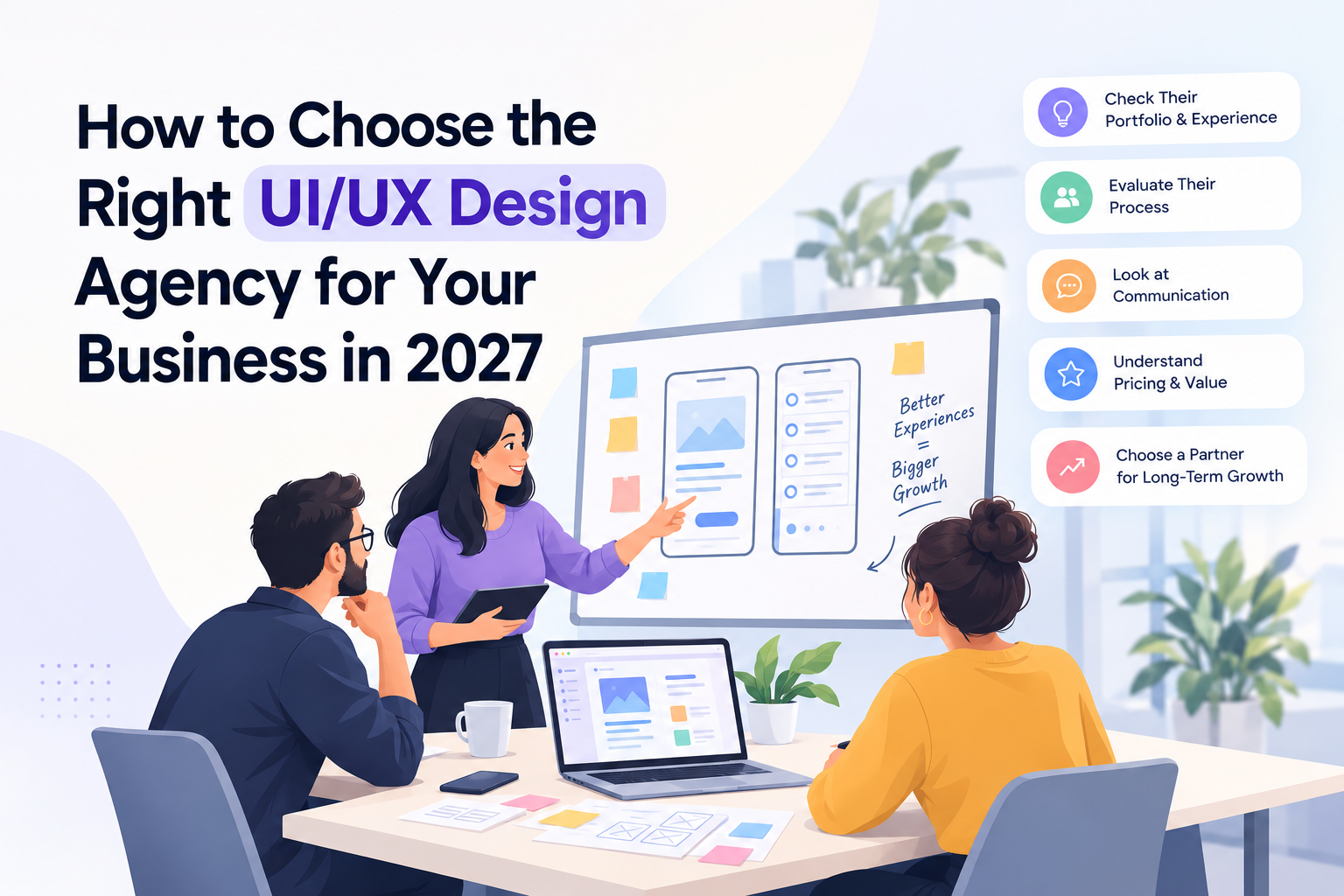
Choosing a UI/UX design agency requires more than comparing portfolios or hourly rates. Businesses should evaluate research methods, design process, relevant experience, accessibility practices, developer handoff, and the agency’s ability to connect design decisions with user and business goals.
Before signing a contract, define the problem you want to solve, establish measurable objectives, compare proposals against the same criteria, and clarify deliverables and ownership.
The right design partner should not simply make your product look better. It should help make the product easier to understand, more useful to its intended audience, and better aligned with your business objectives.