

The UX Investment Isn’t a Design Budget Line. It’s a Development Cost Reduction Strategy.
Product teams working inside quarterly targets rarely have time to argue about design philosophy. They have sprint deadlines, engineering backlogs, and a list of features that stakeholders wanted shipped yesterday. In that environment, UX research feels like a luxury, something done after the product is “real,” or not at all. That instinct is costing companies far more than the UX budget they chose not to spend.
The pattern is consistent across industries: a product ships without serious user testing, adoption is lower than projected, and then the team spends the next two quarters patching problems that could have been diagnosed in a two-week discovery sprint. The developers who were supposed to move onto the next product are instead rewriting flows they already built. Budgets slip. Timelines slip. And no one files it under “UX failure”,they call it “iteration.”
The Cost Is Already Climbing Before a Line of Code Gets Written
The Systems Sciences Institute at IBM has produced some of the most cited research on where development money actually disappears. Their findings show it costs six times more to fix a bug found during implementation than one identified during the design phase. Bugs found during the testing phase can cost up to fifteen times more to fix. When that same logic extends to UX problems, flows that users can’t navigate, labeling that confuses, interactions that don’t match mental models, the multiplier doesn’t shrink. It compounds.
Development teams spend, on average, 30 to 50 percent of their time fixing bugs and dealing with unplanned rework. That number rarely shows up in a project post-mortem as a UX failure. It shows up as engineering hours, sprint rollovers, and missed release windows. But a significant portion of that rework traces back to requirements that weren’t properly validated against real user behavior before development started.
Forrester’s research, widely cited across product strategy literature, puts the ROI of UX investment at roughly $100 returned for every $1 spent. The return comes through improved customer loyalty, streamlined operational efficiency, and lower customer support costs,not just better interfaces. Those are the line items that product leaders and CTOs care about. The design team just happens to be the mechanism that drives them.
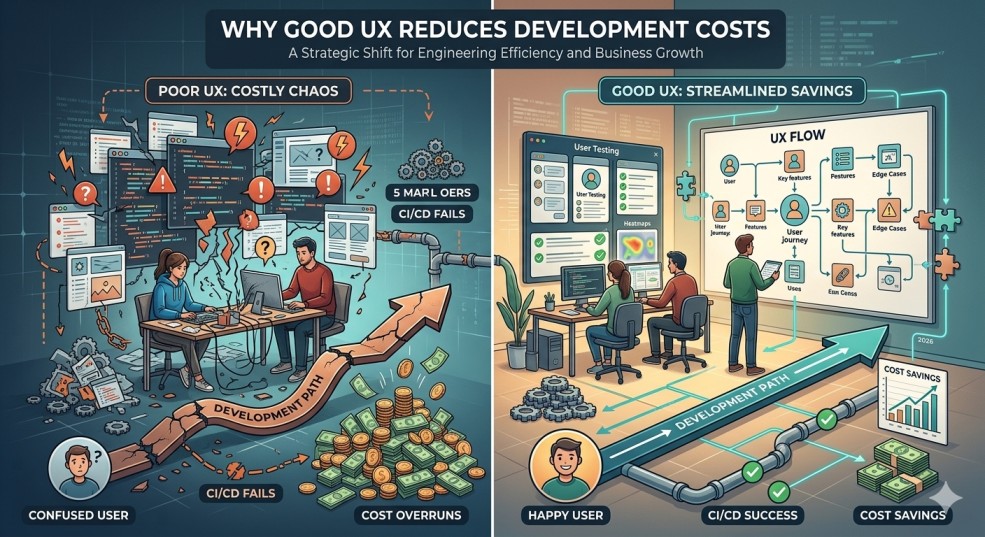
The practical implication is straightforward. Teams that front-load UX research, user interviews, information architecture validation, wireframe testing, are essentially making decisions on paper rather than in production code. Every conflict resolved in a Figma prototype is a conflict that didn’t require a pull request, a QA cycle, and a redeployment.
The process for doing this well isn’t complicated. It typically looks like this:
- Define user problems before defining features, through structured interviews, competitor flow analysis, and job-to-be-done mapping.
- Test with low-fidelity prototypes before any engineering sprint begins, then refine once before handoff.
That’s not a radical process. It’s just disciplined sequencing. The cost is measured in design days. The savings are measured in developer weeks.
What IBM, Airbnb, and GeekyAnts Are Actually Doing
IBM’s investment in design thinking is one of the more documented examples of UX producing measurable development efficiency. A Forrester analysis of IBM’s Design Thinking practice showed $48.4 million in benefits against $12 million in costs over three years, generating a net present value of $36.3 million and an ROI of 301%. More relevant to development teams: IBM found that companies using design thinking to build new solutions saw a 75 percent reduction in development time and a 33 percent reduction in development costs. These are not soft benefits, they translate directly into headcount efficiency and release velocity.
On specific projects, IBM’s design-thinking approach reduced minor projects from 24-week expected timelines to 16 weeks with cost savings of $222,783, and reduced major projects from 60-week timelines to 40 weeks, saving $1,137,534. The mechanism in both cases was the same: understanding the human problem clearly before committing engineering resources to a solution.
Airbnb’s origin story is often told as a startup folklore piece, but the operational detail matters here. In 2009, when Airbnb was generating just $200 per week, the founders stopped building and instead visited properties listed on their platform, looking at their product through the eyes of users rather than developers. Within a week of acting on what they found, revenue doubled. That wasn’t a design refresh. It was a diagnostic exercise that cost the price of a flight and produced a compounding return.
GeekyAnts, a design and development studio with over 17 years of delivery experience, has published its approach to early-stage UX decisions. Their documented process treats rapid wireframing not as a finishing step but as a speed-and-logic exercise, the principle being “fail on paper, not in production.” The approach is deliberately lightweight: surface assumptions, stress-test them with competitor analysis and quick user feedback, then hand off to developers with decisions already made. Their case work spans banking platforms, SaaS builds, and healthcare applications, consistently framing UX as a mechanism for reducing development turnaround time rather than a separate creative phase.
The Compounding Problem No One Budgets For
The deeper issue isn’t any single redesign cost. It’s what late-stage UX failures do to engineering culture and product momentum over time.
When developers are pulled off new work to fix usability problems that users reported post-launch, the opportunity cost isn’t just the hours lost. It’s the next feature that slips, the next sprint that gets compressed, the next release that goes out undertested because the team is still paying down UX debt from three quarters ago. Organizations that apply user-centered approaches to design report reduced overall design defects and faster development and testing cycles,not because the designers worked harder, but because developers received clearer specifications built on validated user understanding.
McKinsey research found that companies focused on design, including UX,generated 32 percent more revenue and delivered 56 percent higher total returns to shareholders compared to their peers. That performance gap doesn’t come from aesthetics. It comes from shipping products that users actually adopt, reducing the support burden, shortening the feedback-to-fix cycle, and spending engineering hours on growth rather than repair.
The business case for investing in UX upstream isn’t an argument about design quality. It’s an argument about where the development budget goes,and whether it’s being spent once on building things right, or twice on fixing things that shouldn’t have needed fixing. Most product teams already know which situation they’re in. The question is whether they’re willing to change the process that got them there.