

Enterprise SaaS platforms are entering a new phase of competition in 2026. For years, software providers focused heavily on feature expansion, cloud scalability, and integration ecosystems. Those capabilities still matter, but they no longer guarantee product adoption or long-term retention. Enterprise buyers now expect SaaS platforms to reduce operational friction, simplify workflows, and improve decision-making in real time.
This shift is pushing AI UX design into the center of SaaS product strategy.
Across North America, enterprise technology leaders are under pressure to improve customer retention, platform engagement, employee productivity, and digital transformation outcomes without dramatically increasing engineering costs. Traditional UX systems struggle to meet those expectations because enterprise users no longer want static dashboards and complex navigation structures. They expect software to behave intelligently.
AI-powered UX is solving that problem by turning SaaS applications into adaptive systems that respond to user intent, automate repetitive tasks, and personalize experiences at scale.
According to recent enterprise software trends from Gartner and McKinsey & Company, generative AI adoption in enterprise software ecosystems accelerated significantly during 2025, especially across customer platforms, analytics tools, HR systems, fintech infrastructure, and productivity suites. However, many organizations discovered that adding AI models alone did not improve adoption. The real differentiator became user experience design.
This is why SaaS companies are restructuring product roadmaps around AI UX design rather than treating AI as an isolated feature layer.
SaaS Interfaces Are Becoming Adaptive Systems
One of the biggest changes happening in SaaS UX is the move away from static interfaces toward adaptive product experiences.
Enterprise platforms historically forced users to learn software logic through training sessions, documentation, and layered workflows. This model created operational inefficiencies inside large organizations because employees spent significant time navigating software instead of completing tasks.
AI UX systems are reversing that experience.
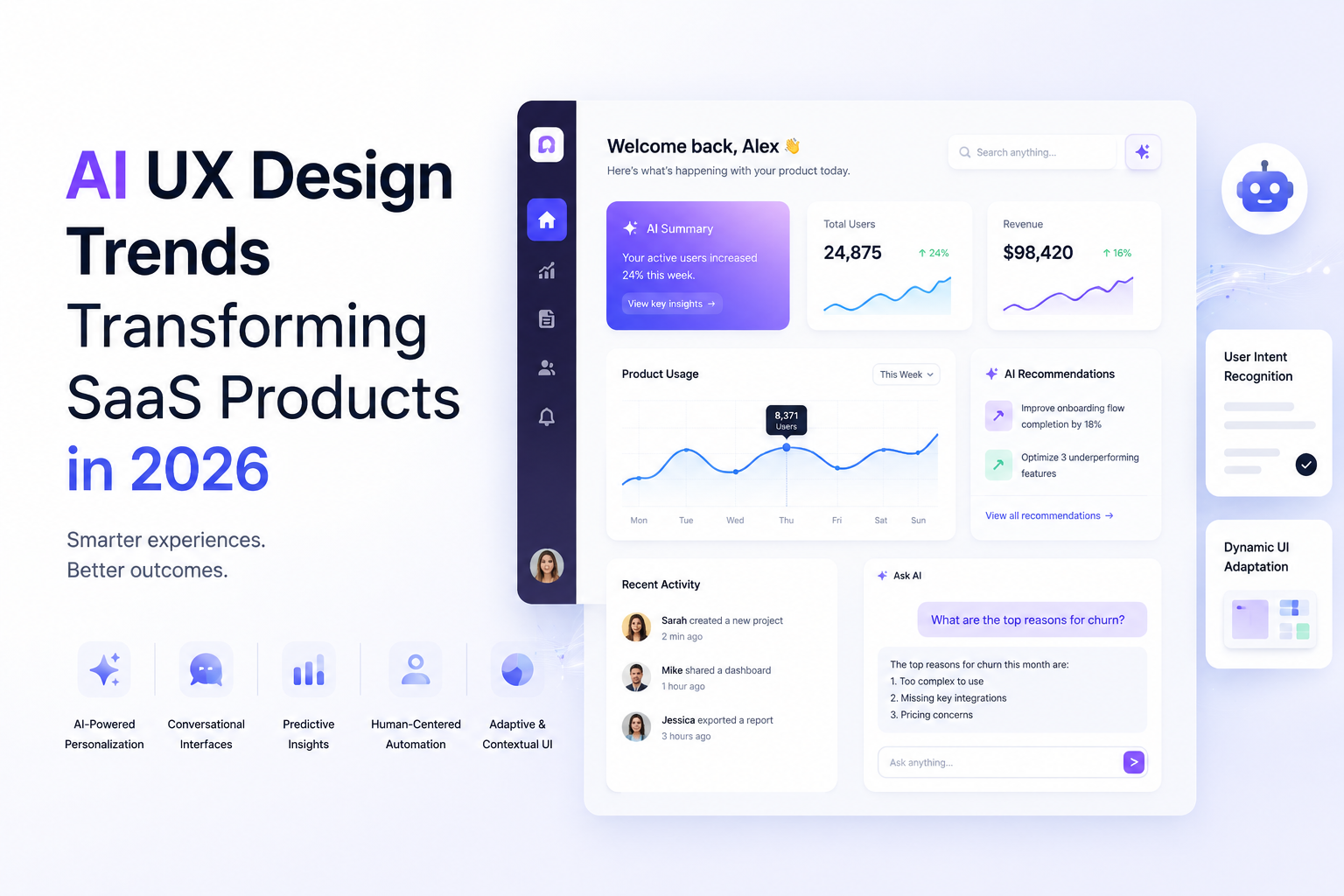
Modern SaaS platforms now analyze behavioral signals, workflow patterns, role-specific actions, and historical usage data to dynamically adapt interfaces for different users. Instead of presenting identical dashboards to every department, AI-driven SaaS products surface context-aware recommendations, workflows, and actions based on user priorities.
For enterprise leaders, this directly impacts productivity KPIs.
A procurement manager, for example, no longer needs to manually search through workflow layers to identify approval bottlenecks. AI-powered UX systems can proactively highlight pending risks, recommend actions, and automate repetitive approvals within the interface itself.
This trend is especially important for enterprises managing multi-platform ecosystems where employees frequently experience dashboard fatigue.
Companies investing in adaptive UX architecture are seeing improvements in onboarding efficiency, time-to-productivity, and feature adoption rates because the product experience adjusts to the user instead of forcing users to adapt to the software.
Organizations like Salesforce, Microsoft, and HubSpot are aggressively integrating AI-driven workflow personalization into their SaaS ecosystems. At the same time, product engineering firms such as GeekyAnts, Thoughtworks, and EPAM Systems are helping enterprises modernize UX layers for AI-native applications.
The competitive advantage is no longer about adding more features. It is about reducing the cognitive load required to use those features.
Conversational UX and AI Copilots Are Reshaping Enterprise SaaS
The rise of AI copilots is also changing how enterprise users interact with SaaS platforms.
In 2026, conversational UX is becoming a default expectation across enterprise products. Employees increasingly prefer interacting with systems through prompts, contextual suggestions, and natural language workflows instead of traditional navigation-heavy interfaces.
This transition matters because enterprise SaaS complexity has become a major operational problem.
Large organizations often operate with fragmented systems across finance, operations, HR, customer support, analytics, and cloud infrastructure. Employees waste significant time switching between tools, manually extracting insights, and completing repetitive actions.
AI copilots reduce that friction.
Instead of opening multiple dashboards, users can ask a SaaS platform questions directly:
- “Show contracts delayed beyond SLA targets.”
- “Generate a quarterly customer churn summary.”
- “Identify accounts with declining product usage.”
- “Create a compliance report for this region.”
The UX layer becomes conversational rather than navigational.
For VP-level technology leaders, this trend creates both opportunity and risk. AI copilots can significantly improve operational efficiency, but poorly designed conversational UX often creates confusion, inaccurate outputs, and governance concerns.
This is why explainability is becoming a critical AI UX principle in enterprise SaaS environments.
Enterprise users want visibility into how recommendations are generated, what data sources are being used, and whether outputs can be trusted. AI interfaces that fail to provide transparency often reduce adoption rather than improve it.
As a result, enterprise SaaS providers are investing heavily in explainable AI UX patterns, confidence scoring, audit visibility, and human-in-the-loop workflows.
Invisible UX and Workflow Automation Are Becoming Competitive Advantages
Another major AI UX trend shaping SaaS products in 2026 is invisible UX.
Invisible UX refers to systems where automation happens quietly in the background with minimal user interruption. Instead of requiring employees to initiate every action manually, AI systems proactively handle repetitive operational tasks.
This trend is becoming increasingly valuable for enterprise teams dealing with operational scale.
Examples include:
- Automated workflow prioritization
- Predictive customer support routing
- AI-generated summaries for meetings and tickets
- Smart notification filtering
- Automated compliance validation
- Intelligent onboarding assistance
The goal is not to overwhelm users with AI features. The goal is to reduce interface friction.
Many enterprise SaaS platforms failed during the first wave of AI implementation because they introduced excessive prompts, assistant windows, and automation layers that complicated workflows instead of simplifying them.
In 2026, successful SaaS UX strategies are becoming quieter and more embedded into operational workflows.
This is particularly important for industries like healthcare, fintech, logistics, cybersecurity, and enterprise operations where employees already work within high-pressure environments. Reducing clicks, navigation steps, and repetitive actions can create measurable efficiency gains at scale.
Enterprise leaders are now evaluating AI UX investments through operational metrics rather than visual innovation alone. They want to know:
- Will this reduce employee workload?
- Will this improve retention and engagement?
- Will this accelerate onboarding?
- Will this reduce support tickets?
- Will this improve revenue operations?
The conversation around UX has shifted from aesthetics to operational performance.
What Enterprise SaaS Leaders Should Prioritize in 2026
Many enterprises still approach AI UX transformation reactively. They experiment with isolated AI features without redesigning the broader product experience around user workflows.
That strategy is becoming increasingly ineffective.
In 2026, successful enterprise SaaS organizations are focusing on three priorities simultaneously: AI infrastructure readiness, adaptive UX systems, and governance-first product design.
Technology leaders are also recognizing that AI UX transformation requires closer collaboration between engineering, product strategy, design systems, cloud infrastructure, and customer experience teams.
This is creating new demand for cross-functional product modernization partners capable of aligning AI capabilities with enterprise usability requirements.
Companies like Accenture, and Cognizant are increasingly involved in AI-native product engineering conversations because enterprises are looking beyond standalone AI deployment toward end-to-end digital experience transformation.
For enterprise decision-makers, the key challenge is no longer whether AI will influence SaaS UX. That transition is already happening. The real challenge is determining how quickly existing platforms can evolve without disrupting operational stability, compliance standards, and customer trust.
Organizations that modernize their SaaS UX architecture early will likely gain advantages in retention, platform adoption, and workflow efficiency over the next several years.
For leadership teams evaluating their next phase of SaaS modernization, this may be the right time to assess whether current product experiences are designed for AI-native user expectations or still optimized for legacy interaction models.