

Healthcare organizations across North America are under pressure to modernize digital experiences while managing operational complexity, regulatory expectations, and rising patient demands. Patients now expect healthcare interactions to feel as seamless as banking, retail, or travel platforms. Yet many enterprise healthcare systems still rely on fragmented portals, outdated interfaces, and disconnected digital workflows that create friction instead of convenience.
For enterprise technology leaders, this shift is no longer about incremental interface improvements. Healthcare UX has become a business performance issue tied directly to patient retention, operational efficiency, clinician productivity, and digital adoption rates.
According to recent industry findings from Deloitte and McKinsey, patient expectations for digital first healthcare experiences continue to rise, especially around self-service scheduling, mobile access, virtual care, and personalized communication. At the same time, large healthcare enterprises face increasing pressure to reduce administrative inefficiencies and improve care accessibility without significantly expanding operational costs.
This creates a difficult balancing act for leaders responsible for engineering, digital platforms, cloud infrastructure, and customer experience. Enterprise healthcare organizations cannot afford large-scale platform disruptions, but they also cannot continue building digital experiences around legacy assumptions.
The most successful organizations are shifting focus from isolated applications to end-to-end patient experience ecosystems. That shift is defining the next phase of healthcare UX.
The Shift From Feature-Heavy Platforms to Frictionless Patient Journeys
Many healthcare organizations spent the last decade investing heavily in digital platforms. However, adoption gaps remain a persistent challenge. In many cases, the issue is not the lack of features. The problem is usability.
Patients often interact with multiple systems during a single healthcare journey. Scheduling platforms, insurance verification tools, payment systems, patient portals, telehealth applications, diagnostic updates, and follow-up communications frequently operate across disconnected environments. Even minor usability gaps can create major operational consequences.
When patients abandon appointment scheduling halfway through a workflow or fail to complete digital intake forms, organizations experience increased call center volume, delayed care coordination, and administrative overhead. These inefficiencies eventually impact revenue cycles and patient satisfaction metrics.
This is why healthcare UX discussions are moving beyond design teams and into executive leadership conversations.
Several trends are driving this transition:
- Patients increasingly prefer mobile-first healthcare interactions.
- Healthcare systems are consolidating through mergers and acquisitions, increasing platform complexity.
- Telehealth and hybrid care models require more intuitive digital workflows.
- AI-powered patient engagement tools are becoming more common.
- Regulatory requirements continue to evolve around accessibility, privacy, and interoperability.
Enterprise healthcare organizations are responding by prioritizing experience consistency across digital touchpoints rather than optimizing isolated applications.
For example, many providers are redesigning appointment systems around reduced cognitive load. Instead of presenting patients with complex service categories and provider directories, newer systems guide users through intent-based workflows that simplify decision-making.
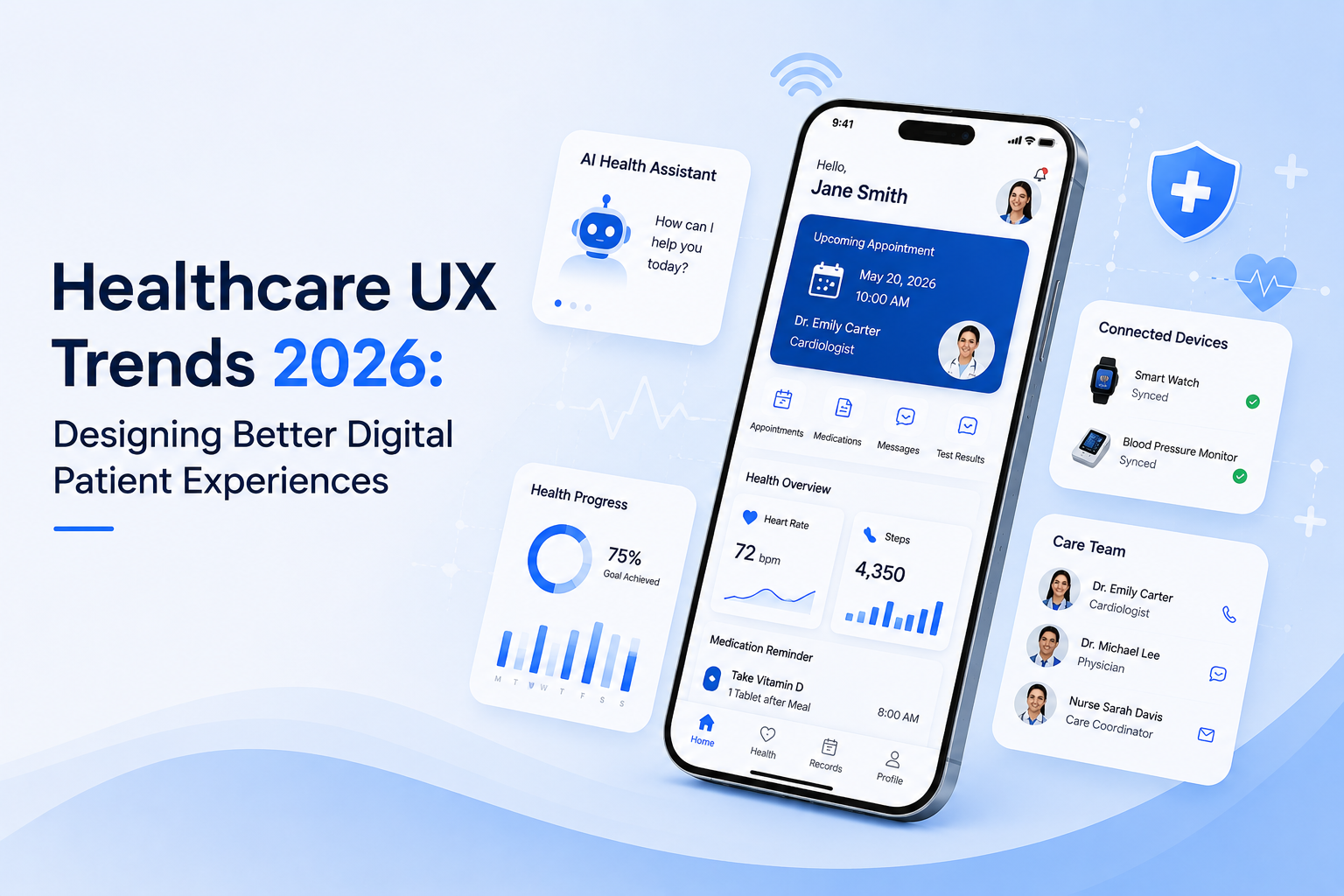
Similarly, patient portals are evolving from static information repositories into dynamic engagement platforms. Organizations are integrating real-time messaging, medication reminders, personalized health insights, and integrated billing experiences into unified interfaces.
Companies like GeekyAnts, Accenture, Cognizant, and Deloitte Digital are actively working with enterprises on healthcare platform modernization initiatives that combine UX transformation with scalable engineering architecture. The market increasingly recognizes that experience design alone cannot solve healthcare usability problems without strong backend integration and infrastructure alignment.
Healthcare UX Trends Reshaping Enterprise Platforms
Several healthcare UX trends are now shaping enterprise technology roadmaps across large healthcare networks, insurers, and digital health providers.
The first major trend is hyper personalization. Healthcare organizations are using analytics and AI-driven systems to tailor patient experiences based on demographics, behavioral patterns, medical history, and communication preferences. Personalized care pathways help reduce drop-offs and improve engagement rates.
However, personalization introduces technical complexity. Enterprise teams must unify fragmented datasets across EHR systems, CRM platforms, cloud environments, and third-party APIs while maintaining HIPAA compliance and security controls.
The second major trend is conversational UX.
Healthcare organizations increasingly deploy AI chat interfaces, voice assistants, and automated triage systems to reduce operational pressure on support teams. Patients now expect immediate responses for routine interactions such as appointment scheduling, prescription renewals, or insurance questions.
This trend creates new demands on platform engineering teams. Conversational systems require strong orchestration between natural language models, patient databases, authentication layers, and workflow automation systems.
The third trend is accessibility-first design.
Healthcare organizations are facing growing scrutiny around inclusive digital experiences. Accessibility is no longer treated solely as a compliance requirement. It directly affects patient reach, engagement, and trust.
Enterprise healthcare providers increasingly prioritize:
- Mobile responsiveness across low-bandwidth environments.
- Multilingual experiences for diverse patient populations.
- WCAG-compliant interfaces for users with disabilities.
- Simplified navigation for elderly and non-technical users.
These priorities are especially important for large healthcare networks operating across multiple regions and demographics.
Another emerging trend is unified care ecosystems.
Instead of treating telehealth, diagnostics, billing, messaging, and care coordination as separate products, organizations are building connected digital ecosystems. Patients increasingly expect continuity across every interaction.
This shift is influencing platform architecture decisions. Technology leaders are investing more heavily in API-first infrastructure, cloud-native systems, and composable architectures that support faster integration between services.
The Infrastructure Challenge Behind Great UX
Despite growing investment in healthcare UX, many enterprise organizations still struggle to execute transformation initiatives at scale.
The biggest barrier is not design capability. It is infrastructure fragmentation.
Large healthcare enterprises often operate across decades of accumulated systems, vendor dependencies, and compliance frameworks. Core healthcare workflows frequently depend on legacy EHR platforms that were never designed for modern digital experiences.
As a result, even straightforward UX improvements can become technically difficult.
For example, implementing a unified patient dashboard may require integration across:
- Multiple EHR systems.
- Insurance verification platforms.
- Laboratory systems.
- Billing environments.
- Third-party telehealth services.
- Identity and access management frameworks.
These dependencies slow development cycles and create delivery bottlenecks for engineering teams.
At the same time, cybersecurity concerns continue to intensify.
Healthcare remains one of the most targeted industries for ransomware and data breaches. Technology leaders must balance usability improvements with strict security, authentication, and privacy requirements.
This often creates tension between compliance teams and product teams.
Organizations that succeed in healthcare UX modernization typically adopt cross-functional operating models where engineering, compliance, design, infrastructure, and business stakeholders collaborate earlier in the development lifecycle.
They also invest more aggressively in platform standardization.
Instead of maintaining isolated digital products, leading enterprises increasingly build shared design systems, reusable components, centralized identity frameworks, and scalable API governance models. These foundational investments reduce long-term delivery friction while improving consistency across patient experiences.
How Enterprise Technology Teams Are Responding
Enterprise healthcare organizations are becoming more strategic about digital experience transformation.
Rather than launching large-scale redesign projects every few years, many organizations are adopting continuous UX optimization models supported by analytics, user behavior monitoring, and iterative product development.
This approach aligns more closely with modern platform engineering practices.
Technology teams are also prioritizing measurable operational outcomes instead of purely visual redesign metrics. Executive leadership increasingly evaluates healthcare UX investments based on factors such as:
- Reduced patient support calls.
- Faster onboarding completion.
- Improved digital appointment conversion.
- Lower administrative overhead.
- Increased telehealth utilization.
- Higher patient retention and satisfaction.
This operational framing helps justify long-term modernization investments at the enterprise level.
Another important shift is the growing collaboration between healthcare organizations and specialized technology consulting firms.
Many enterprises recognize that internal teams alone may struggle to modernize complex healthcare ecosystems while simultaneously maintaining existing operations. As a result, organizations increasingly partner with firms that combine healthcare domain understanding, cloud modernization expertise, and product engineering capabilities.
Firms such as GeekyAnts and other digital engineering consultancies are contributing to this transition by helping enterprises rethink healthcare experiences through scalable frontend architecture, design systems, interoperable platforms, and cross-platform patient applications.
The broader market direction is clear. Healthcare UX is no longer treated as a cosmetic layer added after platform development. It is becoming a core operational strategy tied directly to patient engagement, efficiency, and enterprise competitiveness.
For decision-makers leading engineering, digital transformation, or customer experience initiatives, the challenge is not whether to improve healthcare UX. The challenge is how to modernize digital experiences without disrupting critical systems, increasing delivery risk, or creating unsustainable technical debt.
Organizations that approach healthcare UX as a platform-level transformation initiative rather than a design refresh are more likely to achieve sustainable results.
As healthcare ecosystems continue evolving across North America, enterprise leaders will increasingly need partners, frameworks, and engineering strategies that align patient experience goals with long-term infrastructure scalability. That conversation is becoming central to the future of digital healthcare transformation.