

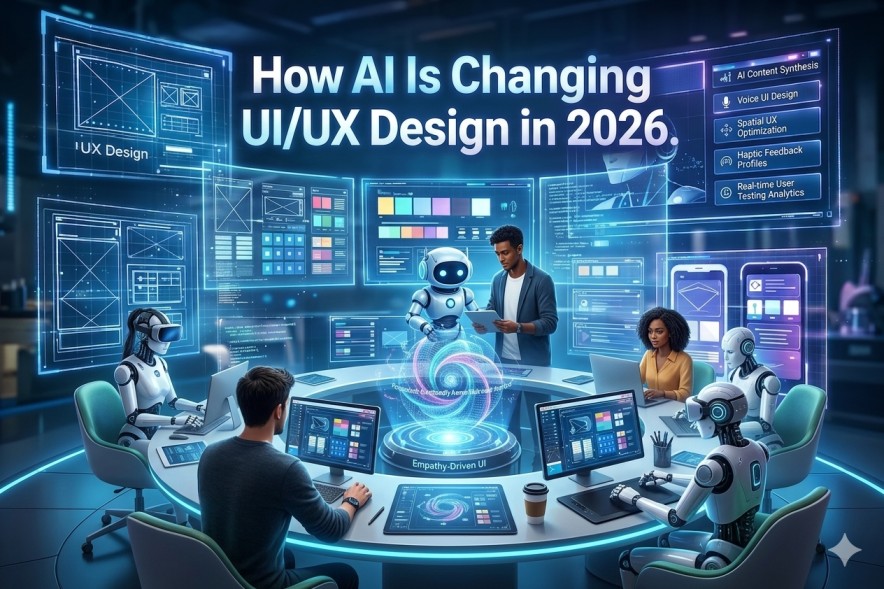
AI is no longer an experimental layer in digital products. In 2026, it is quietly redefining how interfaces behave, how users interact, and how product teams ship experiences at scale.
For enterprise leaders, the conversation has moved beyond adoption. The real concern now is control—over cost, consistency, and outcomes.
Most organisations are already embedding AI into their design workflows. Yet many are seeing a familiar pattern: early gains in engagement, followed by rising complexity, unclear ROI, and systems that are harder to manage than they were before.
This is not a tooling problem. It is an operating model gap.
UI/UX Is Moving From Static Design to Adaptive Systems
Traditional UI/UX was built on predictability. Teams designed flows, validated them, and scaled them through design systems that enforced consistency.
AI breaks that model.
Interfaces are no longer fixed. They adapt in real time based on user behavior, intent signals, and contextual data. Navigation paths shift. Content reorganizes. Recommendations evolve continuously.
This changes where complexity lives.
Instead of managing screens, teams are now managing decision systems—models, data pipelines, and logic layers that determine what each user sees.
The impact is immediate:
- Design loses deterministic control
- Engineering inherits variability
- Product teams struggle to measure consistent outcomes
Many AI-driven UX initiatives stall at this point—not because the technology fails, but because the organisation is still operating as if UI is static.
Two Shifts Driving the Biggest Impact
- Personalization Is Becoming Default—Not Differentiation
AI has made real-time personalisation scalable across enterprise platforms. Interfaces can now adapt to individual users across millions of sessions.
This is already improving conversion and engagement in measurable ways.
But the trade-off is becoming harder to ignore.
Personalization introduces:
- Higher infrastructure and inference costs
- Increased experimentation overhead
- More complex debugging and validation cycles
What looks like a UX improvement often becomes a cost and operations challenge at scale. Many teams discover too late that not all personalisation delivers proportional business value.
- Design Systems Are Becoming Controlled, Not Static
Design systems are evolving from rigid rulebooks into controlled environments for AI-driven variability.
Components are no longer fixed—they adapt based on context and model outputs. This creates a tension:
How do teams maintain brand consistency while allowing interfaces to evolve?
Leading organisations are solving this by defining constraints instead of enforcing uniformity. They allow AI to operate within boundaries—ensuring flexibility without losing control.
The Operational Reality Most Leaders Underestimate
AI-driven UI/UX does not simplify delivery. It redistributes complexity.
Engineering teams are now responsible for:
- Data pipelines and model performance
- Real-time analytics and observability
- Continuous experimentation infrastructure
At the same time, interfaces are no longer released—they are continuously optimised in production.
This creates a measurement gap. Without strong attribution, teams struggle to identify what is actually driving revenue versus what is increasing cost.
Cost itself becomes dynamic. AI-driven experiences scale with usage, making FinOps an engineering concern rather than just a finance function.
How Leading Companies Are Turning This Into Advantage
Organisations that are getting this right are not necessarily building more AI—they are applying it more selectively and systematically.
Companies like GeekyAnts, Accenture, and Thoughtworks are working with enterprise clients to embed AI directly into design and engineering workflows rather than treating it as an add-on.
Their approach tends to follow a few consistent patterns:
- Align AI-driven UX decisions with measurable business outcomes early
- Build adaptive design systems with clear guardrails
- Integrate AI across frontend, backend, and data layers from the start
In practice, this shows up in areas like:
- Intelligent onboarding flows that adjust in real time
- Context-aware dashboards that reduce decision friction
- AI-assisted interfaces in domains like fintech, healthcare, and logistics
The advantage is not just better UX. It is faster iteration, more targeted personalisation, and tighter control over cost-performance trade-offs.
The Strategic Question for 2026
AI is not replacing UI/UX design. It is changing its role—from designing interfaces to shaping adaptive systems.
For enterprise leaders, the challenge is not whether to move in this direction. It is how to do it without:
- Expanding operational complexity beyond control
- Increasing costs without measurable returns
- Compromising consistency and trust
The gap between teams that experiment with AI in UX and those that scale it is widening.
It rarely comes down to access to tools.
It comes down to whether the organization is willing to rethink how design, engineering, and data operate as a unified system.
That is typically where the conversation shifts—from tools and features to architecture, governance, and long-term efficiency.
FAQs: AI in UI/UX for Enterprise Leaders
- Is AI replacing traditional UI/UX design roles?
No. It is shifting their focus. Designers are moving from crafting static screens to defining systems, behaviors, and constraints for adaptive experiences. - What is the biggest risk in AI-driven UX adoption?
Uncontrolled complexity. Without governance and measurement, AI can increase costs and reduce consistency faster than it improves experience. - How should enterprises measure ROI on AI in UX?
Tie it directly to business metrics such as conversion rates, retention, task completion time, and support cost reduction—not just engagement. - When should teams avoid using AI in UI/UX?
In flows where consistency, compliance, or predictability is critical—such as regulated transactions or high-risk decision points. - How can teams control the cost of AI-driven experiences?
By limiting personalisation to high-impact areas, optimizing model usage, and embedding cost-awareness into engineering and design decisions. - What is the first step to scaling AI in UX effectively?
Start with a clear operating model—align design, engineering, and data teams early, and define guardrails before scaling experimentation.