

Enterprise leaders rarely struggle to justify engineering investments. Infrastructure, security, and platform modernization have clear cost-benefit narratives. UI/UX design, however, still gets debated in budget reviews—often perceived as subjective, aesthetic, or secondary to “core functionality.”
That perception quietly erodes revenue.
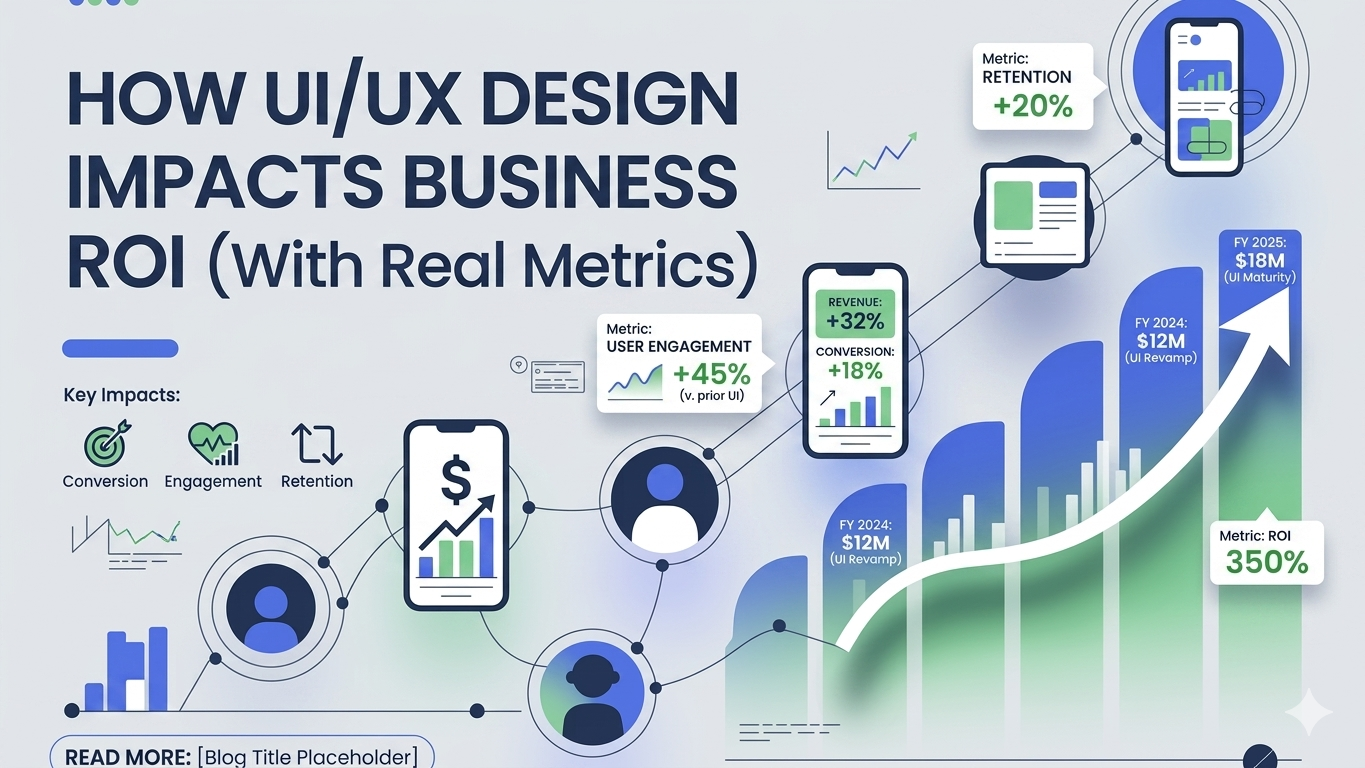
For organizations operating at $500M+ scale, user experience is no longer a layer—it is a multiplier. It directly influences conversion rates, customer retention, operational efficiency, and even engineering velocity. When measured correctly, UI/UX is not a design expense. It is a performance lever tied to ROI.
This article breaks down how UI/UX impacts business outcomes using real metrics, where enterprises typically miscalculate its value, and how leadership teams can approach UX investments with the same rigor as platform engineering.
The Hidden Cost of Poor UX in Enterprise Systems
Most enterprise systems do not fail loudly. They degrade performance quietly.
A checkout flow that adds friction reduces conversion rates incrementally. A dashboard that takes longer to interpret slows decision-making across teams. An onboarding experience that confuses users increases churn before value realization.
Individually, these issues look small. At scale, they compound into measurable losses.
Industry research from organizations like Forrester consistently highlights that every dollar invested in UX can return significantly higher value when aligned with business outcomes. While the exact multiplier varies, the directional insight holds: UX improvements disproportionately impact revenue compared to their cost.
Consider three areas where poor UX directly impacts ROI:
- Conversion leakage: Even a 1% drop in conversion for a high-traffic product can translate into millions in lost revenue annually.
- Support overhead: Complex interfaces increase customer support tickets, raising operational costs.
- Time-to-value delays: Users take longer to realize product value, affecting retention and expansion revenue.
Executives often attribute these outcomes to market conditions or product-market fit. In many cases, the root cause is interaction design.
Where UX Drives Measurable ROI
The challenge is not proving that UX matters. It is isolating where it delivers measurable business impact.
Conversion Rate Optimization
UI/UX design directly influences how users move through critical journeys—signup, checkout, onboarding, and feature adoption.
A well-documented pattern across UX case studies shows that simplifying checkout flows can increase conversion rates by double-digit percentages. Reducing form fields, improving visual hierarchy, and optimizing mobile responsiveness are not cosmetic changes—they remove friction from revenue-generating paths.
For enterprise SaaS platforms, even marginal gains in onboarding completion rates significantly impact annual recurring revenue.
Customer Retention and Lifetime Value
Retention is where UX delivers compounding returns.
When users can intuitively navigate a product, find value quickly, and complete tasks without friction, they are more likely to stay. This directly increases customer lifetime value and reduces churn.
Poor UX, on the other hand, creates “silent churn.” Users do not always complain—they disengage.
Research across UX platforms consistently shows that small improvements in retention can drive disproportionate profit growth, particularly in subscription-based models.
Operational Efficiency
UX does not only impact customers—it affects internal teams.
Enterprise tools with poor usability slow down employees, increase training time, and create dependency on support teams. This translates into hidden operational costs.
Improving internal UX can reduce task completion time, lower training overhead, and increase employee productivity. At enterprise scale, even incremental efficiency gains translate into significant financial impact.
Why Enterprises Struggle to Realize UX ROI
Despite clear benefits, many organizations fail to capture UX-driven ROI. The issue is rarely capability—it is alignment.
UX is often treated as a late-stage activity. Design enters after product requirements are locked, limiting its impact to surface-level improvements rather than shaping user journeys.
Metrics are frequently disconnected from business outcomes. Teams track usability scores or satisfaction metrics without linking them to revenue, retention, or cost savings.
Design systems also lack scalability. Without standardization, teams duplicate effort, increasing costs and reducing consistency across products.
Closing these gaps requires a shift from viewing UX as a function to treating it as an integrated system within product development.
A Practical Framework for Measuring UX ROI
Executives do not need more design theory. They need a way to connect UX decisions to financial outcomes.
A structured approach helps.
Map UX metrics directly to business KPIs. Task success rates should connect to conversion rates. Time on task should reflect operational efficiency. Error rates should tie back to support costs.
Prioritize high-impact journeys such as onboarding, checkout, and core feature interactions. These areas directly influence revenue and cost structures.
Implement continuous testing. Organizations that rely on ongoing A/B testing and iterative improvements consistently outperform those that depend on periodic redesigns.
How Leading Companies Are Using UX as a Competitive Advantage
Forward-looking organizations no longer treat UX as a support function—they operationalize it as part of their growth strategy.
Companies like Airbnb and Amazon have long demonstrated how experience design directly impacts revenue. From frictionless booking flows to one-click purchasing, their UX decisions are tightly coupled with conversion and retention metrics.
What is changing in 2026 is how engineering-led organizations are adopting similar principles internally.
Firms like GeekyAnts are embedding UX into platform engineering workflows rather than treating it as a downstream activity. Their approach focuses on aligning design systems with development pipelines, ensuring consistency across applications while reducing time-to-market.
Instead of isolated design efforts, they emphasize:
- Design systems that scale across enterprise products
- UX integrated early in product architecture decisions
- Continuous usability testing tied to measurable KPIs
This allows organizations to reduce rework, accelerate delivery cycles, and improve user adoption simultaneously.
The advantage is not just better interfaces—it is operational efficiency combined with improved business outcomes.
The Strategic Role of UX in Platform-Led Growth
For enterprises investing in digital transformation, UX plays a critical role in adoption.
A platform is only as valuable as its usability.
Internal developer platforms, customer-facing portals, and enterprise applications all depend on user experience to drive engagement. Poor UX slows adoption and increases resistance, undermining transformation initiatives.
As backend systems grow more complex, UX becomes the layer that simplifies that complexity for users. It translates technical capability into usable value.
In this context, UX is not design—it is enablement.
What Leadership Teams Should Do Next
Most organizations already invest in UX. The question is whether that investment is structured to deliver measurable ROI.
Leadership teams should evaluate integration, measurement, and scalability. They should assess whether UX is influencing product strategy, whether metrics are tied to business outcomes, and whether design systems reduce duplication across teams.
These evaluations often reveal immediate opportunities for improvement.
A structured review of high-impact journeys—combined with measurable KPIs—can uncover revenue gains and cost savings without requiring large-scale redesigns.
That discussion often starts informally, as a working session rather than a formal initiative.
FAQs: UI/UX and Business ROI
How quickly can enterprises see ROI from UX improvements?
It depends on the scope, but improvements in high-impact areas like checkout or onboarding can show measurable results within weeks through A/B testing. Larger system-level changes typically deliver ROI over a quarter or two.
Is UX ROI easier to measure in B2C than B2B?
B2C metrics like conversion are more visible, but B2B environments often see stronger ROI through operational efficiency, reduced training costs, and improved adoption of internal tools.
How much should enterprises invest in UX relative to engineering?
There is no fixed ratio, but leading organizations integrate UX within engineering workflows rather than treating it as a separate budget. The focus is on impact, not allocation.
Do design systems really improve ROI?
Yes. Design systems reduce duplication, accelerate development, and ensure consistency. This lowers costs while improving user experience across products.
What is the biggest mistake companies make with UX?
Treating it as a visual layer instead of a strategic function. The highest ROI comes when UX influences product decisions early, not just interface design.
How are companies like GeekyAnts creating measurable UX impact?
They focus on integrating UX into the development lifecycle, aligning design decisions with business KPIs, and building scalable design systems. This approach ensures that UX improvements directly translate into revenue, efficiency, and faster product delivery.